
The system was delivered, the final invoice was paid, and the business went back to work. Then a simple question appears: who fixes an integration when it stops, who changes a business rule, and who knows where the accounts, data, and backups are?
Launch does not answer that. If your business needs a clear owner for software after launch, that responsibility needs to be defined before the next change, not after the first emergency.
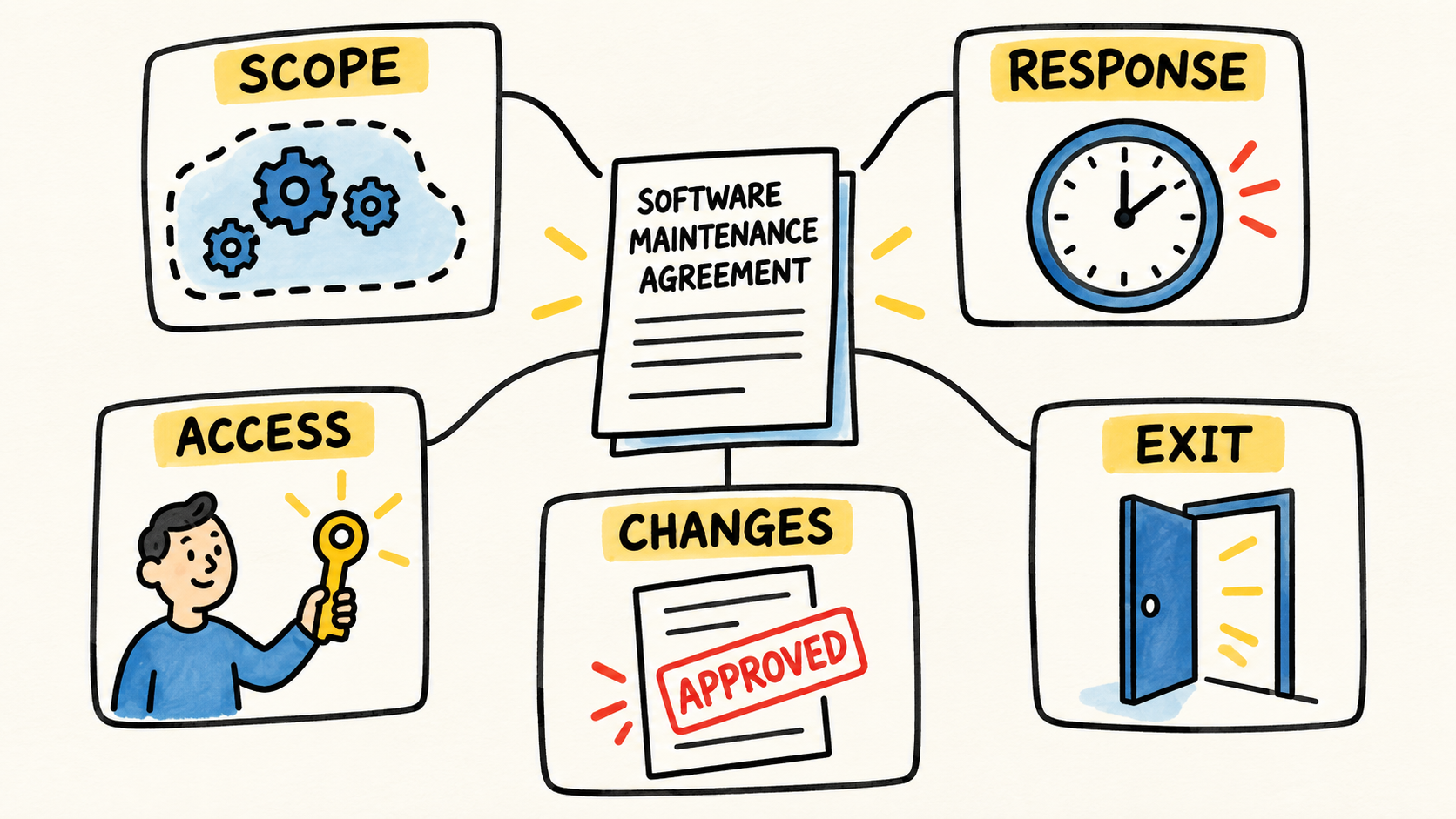
If you are reviewing a support proposal, use this software maintenance agreement checklist to separate scope, access, changes, and exit.
The short answer
- The provider that delivers a system can keep helping, but delivery and ongoing responsibility are different agreements.
- The business should control its accounts, data, access, and a way to request changes without depending on one person’s memory.
- A freelancer, agency, or ongoing owner can work. The risk appears when nobody takes responsibility for maintenance, context, and handoff.
What needs a named owner after launch?
After launch, the question is not only who writes code. It is who keeps the system usable as the business changes. That person or team needs a channel for problems, enough access to investigate, and authority to explain which changes are safe.
Separate the responsibility into four parts:
- Control: hosting, domains, external services, repositories, and payment tools should be tied to the business, with individual access that can be revoked.
- Maintenance: someone tracks updates, failures, backups, and alerts. The agreement should say what counts as support, a change, or work outside the normal hours.
- Context: someone can explain the business rules, data, and connections between systems. Without that, every request starts with a new discovery.
- Handoff: if the provider leaves, another person can take over without asking for a hidden password or relying on a conversation that existed only in the builder’s head.
The FTC’s small-business guidance on vendor security, retrieved August 16, 2026, recommends putting security and data-handling expectations in vendor contracts, checking compliance, and keeping controls current. That is also a buying principle: do not hand over an operation without agreeing how it will be cared for afterward.
How can you tell whether a provider can support the system?
A provider can be good at delivering a project and still be a poor fit for maintaining it for years. Before renewing or buying support, ask for concrete answers:
- Does the business own the main accounts, or are they all under the provider’s login?
- What is included in maintenance, fixes, updates, and new features?
- Where are the code, data, backups, and operating documentation?
- Who responds when an integration fails outside normal hours?
- How can the business export its data and hire someone else?
- Who approves a change that affects sales, billing, or customer service?
- How does the provider record what changed and why?
If the answer is “talk to the developer who knows it,” the problem has already appeared. A provider’s name does not replace an access rule, a change log, or a handoff plan.
The Cybersecurity and Infrastructure Security Agency’s vendor risk template for small and medium businesses, retrieved August 16, 2026, includes questions about updates, patch history, customer responsibility, and business continuity. You do not need to copy the whole document. Use its questions to test whether the agreement still makes sense after delivery.
The most revealing test is a handoff exercise. Imagine the provider cannot help for a month. Does the business know who owns each account, where to export the data, which routine cannot stop, and who decides the next fix? If not, the dependency is not only in the code. It is in the entire relationship.
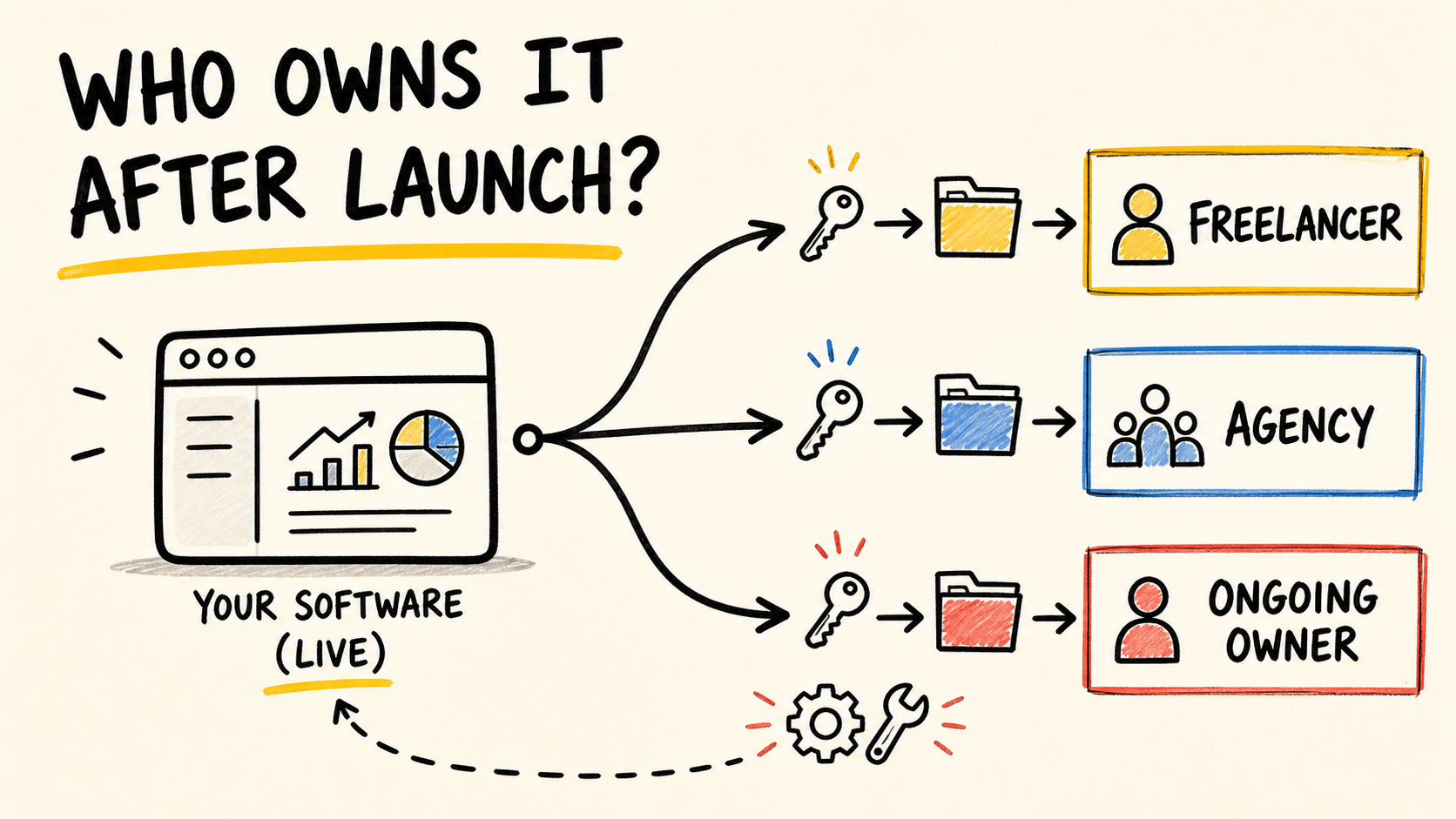
Freelancer, agency, or ongoing owner?
All three options can work. The choice depends on the work the business needs to keep alive, not on the label used in the proposal.
| Option | Often fits when | What must be clear |
|---|---|---|
| Freelancer | The system is small, the work is occasional, and the business can organize the context | availability, company-owned accounts, documentation, and replacement |
| Agency | Several disciplines need coordination or the project has defined deliveries | decision owner, actual delivery team, post-launch support, and history access |
| Ongoing owner | The software participates in operations and changes with the business | priority, support channel, evolution, maintenance, and continuity |
An agency is not automatically more accountable than a freelancer. A freelancer is not automatically closer to the business. What matters is the combination of access, context, availability, and an obligation to explain what happened.
The models can also be combined. A freelancer can deliver an improvement while an internal owner runs the routine. An agency can build the system while another team takes over maintenance. The arrangement is safe only when the change was planned, documented, and tested.
What belongs in the agreement before the next delivery?
Do not treat handoff as a file sent on the last day. Make it a verifiable part of the delivery. This list is short enough for a buying meeting:
- accounts and domains created in the business’s name;
- an inventory of services, integrations, and permissions;
- instructions for the most important operating flows;
- data location and an export procedure;
- a backup and restore routine someone can explain;
- a record of important decisions and changes;
- support hours, channel, and boundary;
- a condition for ending the relationship and transferring the work.
If the software handles customer, order, payment, or employee data, the contract should also say how the provider accesses, protects, returns, and deletes it. The FTC recommends limiting access to what a provider needs and for as long as it needs it. That is an operational requirement a business owner can ask for without knowing how to code.
When does ongoing ownership make sense?
An ongoing owner makes sense when the system is no longer an isolated project. It participates in sales, service, inventory, billing, or a routine the team cannot pause without operational cost.
Another sign is a queue of small changes. If every adjustment requires finding the context again, repeating the story, and waiting for the original provider to find time, the business is paying for missing system memory. Ongoing work does not require a large team. It requires someone to keep priorities, context, access, and responsibility over time.
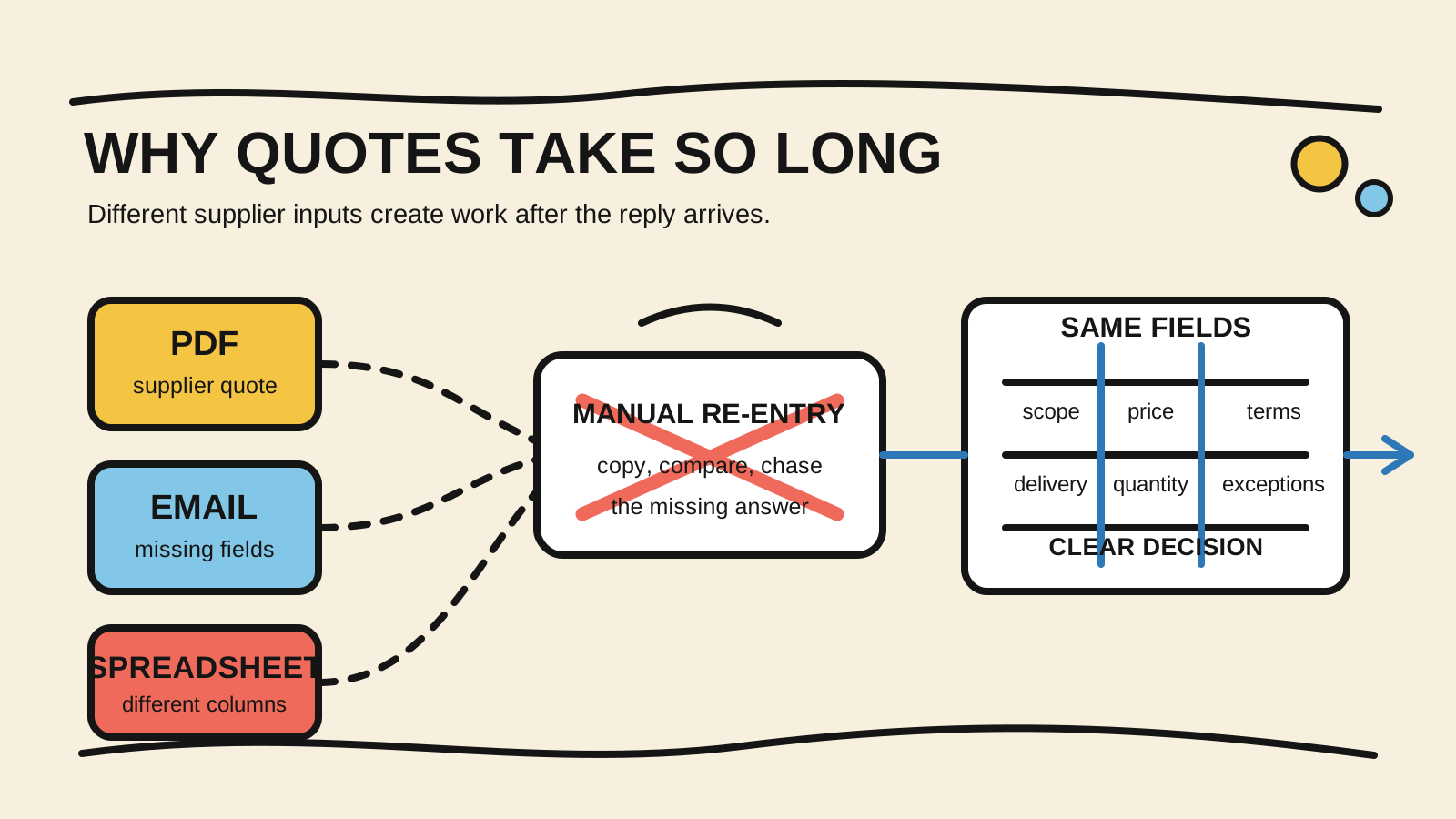
That responsibility also appears before the sale, when a quote waits between sales, operations, and approval. The software owner needs to see that flow, not only fix the screen that produces the PDF.
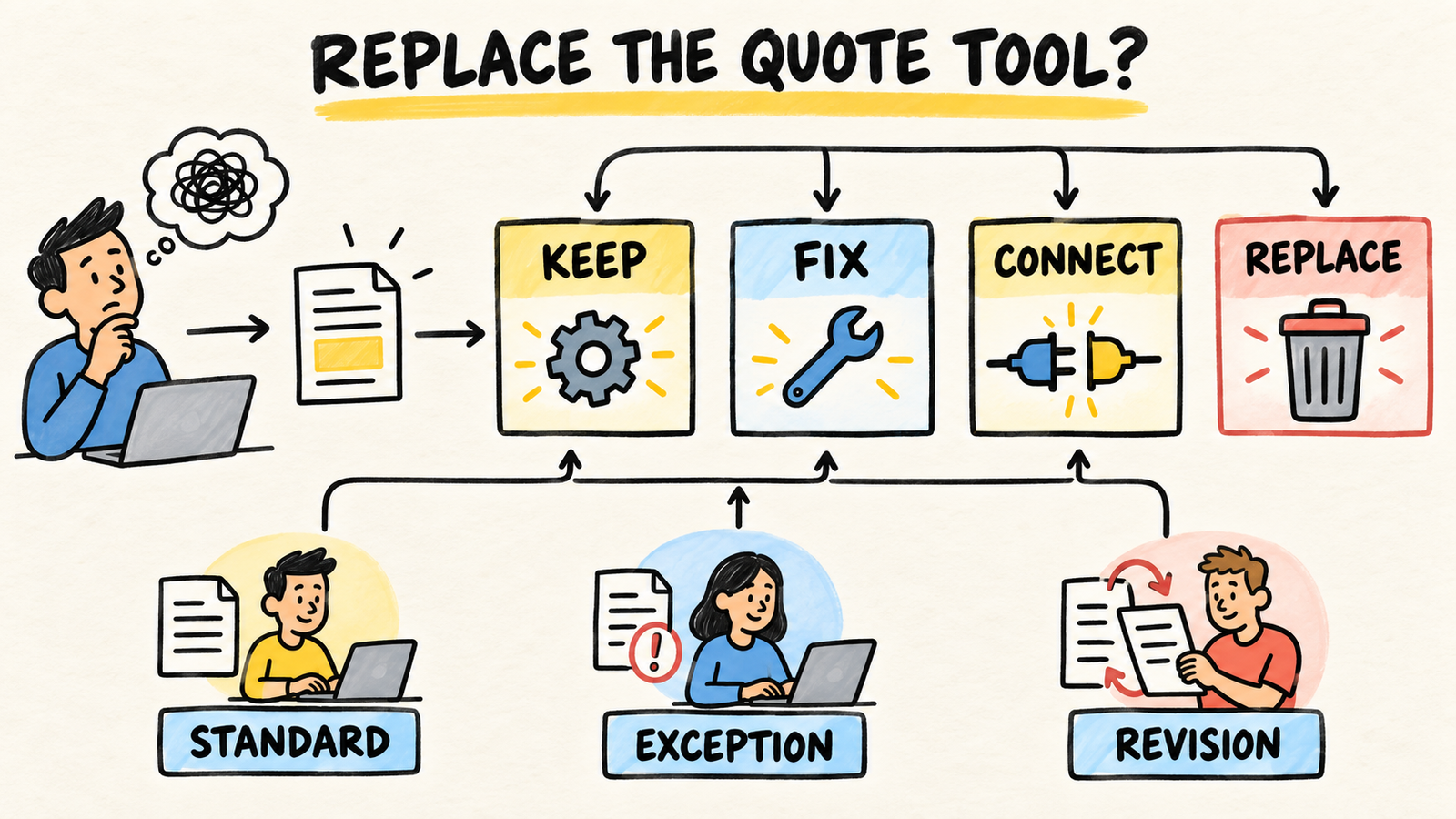
That does not mean building custom software by reflex. Sometimes the right move is to fix the routine or choose ready-made software. The diagnosis of when to replace an inventory spreadsheet shows the same decision pattern: separate the process problem, tool problem, and responsibility problem before choosing who should own the solution.
When the difficulty sits between sales, inventory, and finance, use the diagnosis of business systems that do not talk to each other to separate a process failure from a connection failure.
If that failure makes customers call to ask about an order, the guide to reducing order-status calls shows how to choose between a notice, a page, and human help.
Questions to ask before you sign
Before choosing between the options, use the checklist for comparing software proposals before signing. It helps separate price, scope, acceptance, and continuity.
Who should control the accounts?
The business should be able to enter the accounts that support its operation, using individual access that can be revoked. A provider can administer the work without being the only owner of infrastructure, data, or recovery methods.
Is delivered code enough for someone else to take over?
Not necessarily. A handoff also needs accessible data, configuration, documentation, history, and an explanation of the business flow. Ask for a transition another person can perform, not just a compressed folder.
Does a maintenance contract solve the ownership gap?
Not by itself. A contract helps when it defines scope, channel, response time, access, change records, and exit. If nobody inside the business can approve decisions or explain the operation, support receives requests without context.
Conclusion
If the question is whether there is enough ongoing work to hire someone, see when a small business should hire a software developer. The decision starts with the volume and continuity of the work, not the job title.
Software is not cared for because it launched. It is cared for when someone has the access, context, time, and responsibility to keep the operation working and prepare the next change.
Before choosing a freelancer, agency, or ongoing owner, ask four questions: who controls it, who maintains it, who decides, and who takes over if the relationship ends? If the answer depends on one person, make the handoff part of the work. The system can stay simple. The responsibility cannot stay invisible.
Before choosing the next owner, use the checklist for deciding when to stop buying software tools and review what already exists, who uses each part, and where the operation still depends on manual copying.
If a spreadsheet is also carrying staff schedules and shift changes, use this guide to replacing a scheduling spreadsheet to separate a tool problem from an ownership problem.
If the supplier has already left and you need to regain control before choosing the next model, follow the checklist for taking over after a software developer leaves.
Sources
- Federal Trade Commission, “Cybersecurity for Small Business”, retrieved 2026-08-16, https://www.ftc.gov/business-guidance/small-businesses/cybersecurity
- Cybersecurity and Infrastructure Security Agency, “Operationalizing the Vendor SCRM Template for SMBs”, retrieved 2026-08-16, https://www.cisa.gov/sites/default/files/2025-08/Operationalizing_the_Vendor_SCRM_Template_for_SMBs_2025_Final_508.pdf
- Reddit, “For those who've had a tech person offer to build you something, how did it go?”, retrieved 2026-08-16, https://www.reddit.com/r/smallbusiness/comments/1vd9yd1/for_those_whove_had_a_tech_person_offer_to_build/