
The customer asks for a quote, you say you will check, and the request disappears between a spreadsheet, finance, a supplier, and someone who needs to approve the price. By the time the proposal is ready, the customer has already asked someone else.
A quote takes too long when the work is spread across waits nobody measures. Before buying a system or hiring another person, follow one real request to the sent quote. Mark where information was missing, where someone had to recalculate, and who owned the next step. If the business needs ongoing responsibility for its software, this map also shows what that person will need to maintain.
If the delay starts after supplier replies arrive, see how to compare quotes that come in different formats.
Short answer
- The delay often happens before anyone writes the document: details, pricing, availability, or a margin decision is missing.
- Separate working time from waiting time. They need different fixes.
- Give each quote handoff an owner and a clear condition for moving on.
- Choose software only after you know which part of the process it must control.
What does a quote have to pass through before it goes out?
A quote is more than a PDF. It moves through decisions about the request, price, delivery, and exceptions. Microsoft’s documentation for the estimate and quote process lists customer requirements, quote definition, negotiation, approval, sign-off, and downstream operations as parts of the flow (Microsoft Learn, "Overview of the Estimate and quote sales business process area", retrieved 2026-08-22).
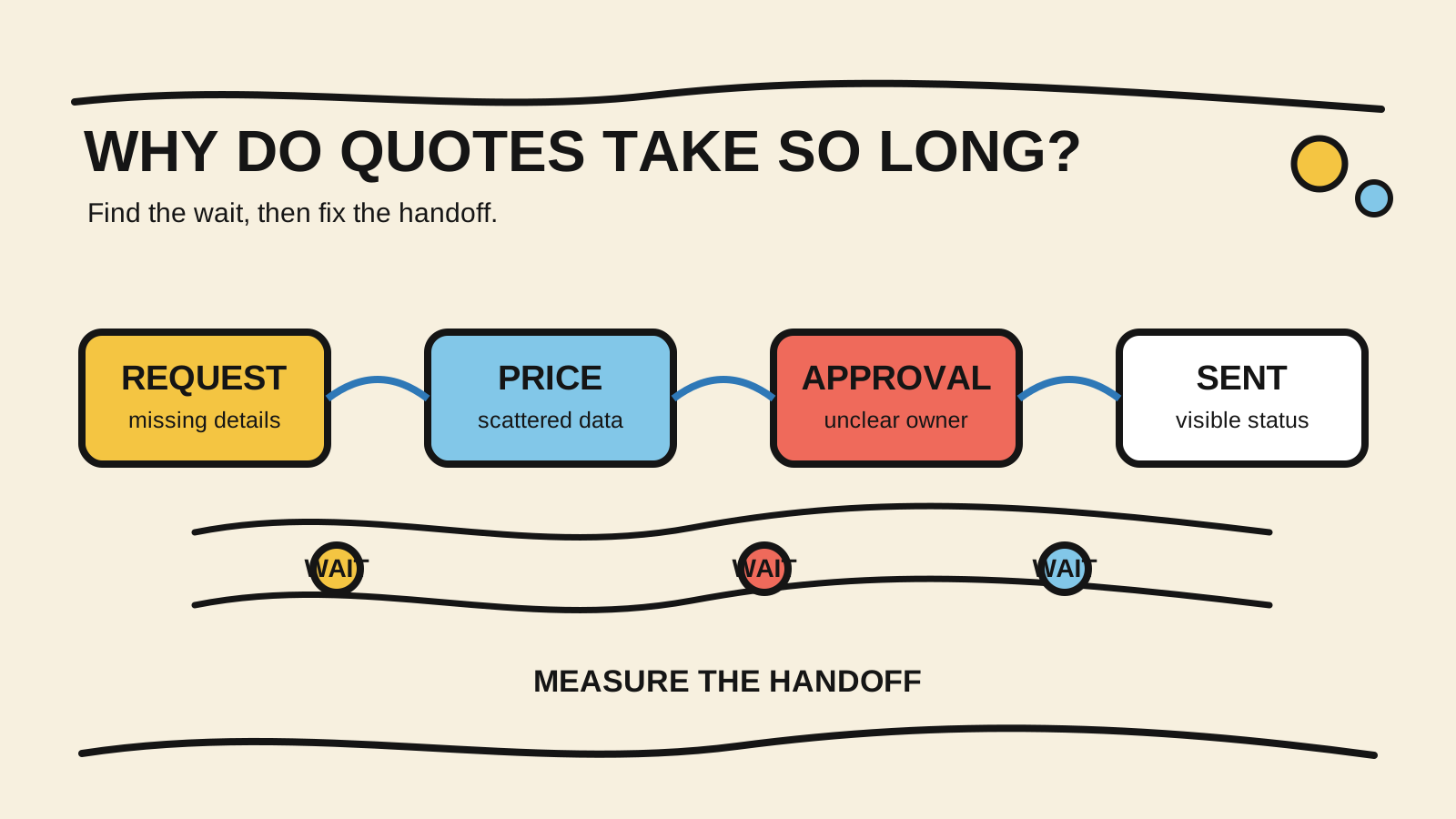
For a smaller business, reduce that flow to four questions:
- Is the request complete enough to assess?
- Can the team calculate price and timing from reliable information?
- Does an exception need approval?
- Who sends the proposal and follows up?
If nobody can say which stage a quote is in, the problem is not just slowness. The process has no visible states. The person handling the customer has to ask again, open several files, and rebuild the history before giving an answer.
The simplest test is to ask someone to describe the path of a quote without opening any tool. If the explanation depends on "that person knows" or "it is in the latest spreadsheet," you have found an operational dependency, even if the final calculation is quick.
Where does a quote usually get stuck?
The waits look the same when you only compare request and delivery dates, but they have different causes. Separate at least these situations before choosing a fix:
- Incomplete request: quantity, measurements, address, scope, or a condition that changes the price is missing. The team is exchanging messages, but the quote has not really entered the work queue.
- Scattered information: price, stock, timing, or customer history lives in different places. Someone has to copy the data and check whether it is current.
- Approval without a rule: a discount, margin, or unusual timing waits for a person who has no clear threshold or visible queue.
- Handoff without an owner: sales asks operations for help, operations replies in another channel, and nobody knows who must return the answer to the customer.
A Bystronic page about quoting in job shops describes similar bottlenecks: manual information, reliance on specialists, and handoff failures can create rework and delay (Bystronic, "How manual quote prep slows down your job shop", retrieved 2026-08-22). The context is industrial, but the distinction between work, waiting, and handoff is useful for any operation that prepares proposals.
Do not turn a vendor source into a promise of results. Use it as a list of hypotheses to check in your own process. What matters is which wait appears in your requests and whether someone can act on it.
How can you find the bottleneck without buying another tool?
Start with recent quotes that represent normal work. You do not need a data project. For each request, record when it arrived, when it became complete, when the price was ready, when approval ended, and when the proposal was sent.
Add two details that often disappear: who had the request and why it was waiting. "Waiting for supplier" is more useful than a column called "in progress." "Missing measurements" points to an intake or conversation problem. "Waiting for approval" calls for a different fix than "nobody saw the message."
Compare a simple quote with one that took too long. If both spend the same time waiting for approval, the limit is in the rule or the approver’s availability. If only incomplete requests stall, start at intake. If the price is ready but the proposal still requires copying data into another file, the problem is in the handoff.
A recent r/smallbusiness discussion recommends separating capacity from waits on engineering, suppliers, pricing, approvals, and follow-up before hiring more salespeople. That comment is public experience and language evidence, not a measurement of every business (r/smallbusiness, "Quote generation process?", retrieved 2026-08-22).
What can you fix in the process before buying software?
The first fixes are often small because they address a wait you can already see. Define what makes a request ready, create one queue, record the current owner, and agree what happens when a stage cannot respond.
Separate standard quotes from exceptions. A price inside the normal rule should not follow the same approval path as an unusual discount. A request without enough information should not have the same state as one ready for pricing. When everything enters a queue called "quotes," the team loses the difference between work, waiting, and blocked work.
Oracle’s documentation for an order quote approval workflow shows states such as pending, approved, and rejected, along with notifications and testing before release (Oracle NetSuite, "Example Workflow: Order Quote Approval", retrieved 2026-08-22). You do not need that product to use the idea: an approval needs a condition, state, owner, and a way to confirm that the flow works.
"Respond faster" is too vague to guide a change. A rule such as "every quote with complete information has an owner and a visible next state" makes the delay observable and gives the team a way to discuss exceptions without blaming the person who received the request.
When does the problem call for software?
Consider a tool when the process repeats across several channels, when the data used for pricing changes often, or when the decision history matters to sales, operations, and finance. The reason is not the number of fields. It is the need to keep the flow reliable after more people start using it.
If the team already avoids the current tool, the checklist for deciding when to replace the quoting system helps separate process rejection from a real product limit.
There are three reasonable paths:
- Improve the current routine. This works when requests are few, rules are known, and a simple queue solves the visibility problem.
- Configure ready-made software. This makes sense when the process is common and the team accepts the product’s model for records, approvals, history, and follow-up.
- Build a specific solution. This may be necessary when quoting depends on business-specific rules, data from several systems, or a handoff current tools cannot represent.
In every case, someone must maintain prices, permissions, integrations, states, and rule changes. The diagnosis of business systems that do not talk to each other helps separate a connection problem from a commercial rule that has not been decided. The guide to who maintains software after launch adds the part that often stays out of the proposal: who answers when the process changes.
Do not buy a demo. Ask the provider to show a complete request, an incomplete request, a rejected approval, and a correction after the quote is sent. If the process works only on the happy path, the software has not shown that it fixes the delay you feel.
What should you ask before hiring a solution provider?
Bring the process map to the conversation. A useful proposal should explain the work between request and response, not just list screens.
- Where does a request enter, and how does the team know it is complete?
- Who can change price, timing, discount, and payment terms?
- Which approvals have clear rules, and which are exceptions?
- How does the owner see that a quote is waiting?
- What happens when a supplier does not respond or information is stale?
- How does an accepted quote become an order without retyping it?
- Who maintains the flow when a business rule or integration changes?
- How does the business export its data and change providers if needed?
If these questions have no answers, the first project may not be development. It may be mapping the process, standardizing the request, and deciding who owns each stage. If the answers exist but the team still copies and waits, you have a clear boundary to configure or build.
Frequently asked questions
Is the problem always a lack of salespeople?
No. A request may be waiting because capacity is limited, but it may also be missing information, pricing, approval, or a defined handoff. Trace the stages before hiring. Adding another person to an unmeasured queue can increase the number of requests without changing the bottleneck.
Should we automate quotes as soon as they get slow?
No. First separate standard work from exceptions and confirm where the request waits. Automating a confusing rule only moves the wrong decision faster. Once the flow is clear, automation can manage states, notifications, repeated data, and conversion to the next step.
Can a spreadsheet remain part of the process?
Yes, if it has a clear purpose, an owner, and a way to review changes. It stops being enough when price depends on versions, nobody knows which file is current, or the team retypes the same data in several places. The issue is control, not the file format.
Conclusion
A quote takes too long when the process hides its waits. Before looking for a tool, follow one request, separate working time from waiting time, and mark the stage nobody can unblock. Then define the intake, states, approval, and person responsible for returning an answer to the customer.
Keep a simple routine if it works. If the process needs shared data, history, and changing rules, compare ready-made software with a specific solution by the flow each one can sustain. Speed starts with visibility. Software comes next.
How this article was researched
This article synthesizes public documentation about quoting workflows, current search results, and operator discussions. Samuel Fajreldines is the accountable author. There is no client case study, private benchmark, or measured result presented as proof. AI assistance shaped the research synthesis and first prose draft; no process execution was invented.
Sources consulted
- Microsoft Learn, "Overview of the Estimate and quote sales business process area", retrieved 2026-08-22
- Oracle NetSuite, "Example Workflow: Order Quote Approval", retrieved 2026-08-22
- Bystronic, "How manual quote prep slows down your job shop", retrieved 2026-08-22
- r/smallbusiness, "Quote generation process?", retrieved 2026-08-22