
Reasoning model
Handles the main conversation, the difficult reasoning, and the code changes.
/model or /tiers reasoning
Open source · Apache-2.0
Distill is a lightweight coding agent harness and terminal UI. It runs on the Grok and Codex subscriptions you already pay for, on OpenRouter, or on any model that speaks the OpenAI-compatible protocol. It reduces what your tools hand back before that text reaches the model.
curl -fsSL https://raw.githubusercontent.com/samuelfaj/distill/main/install.sh | sh
macOS, Linux, and Windows. Upgrade later with distill update.
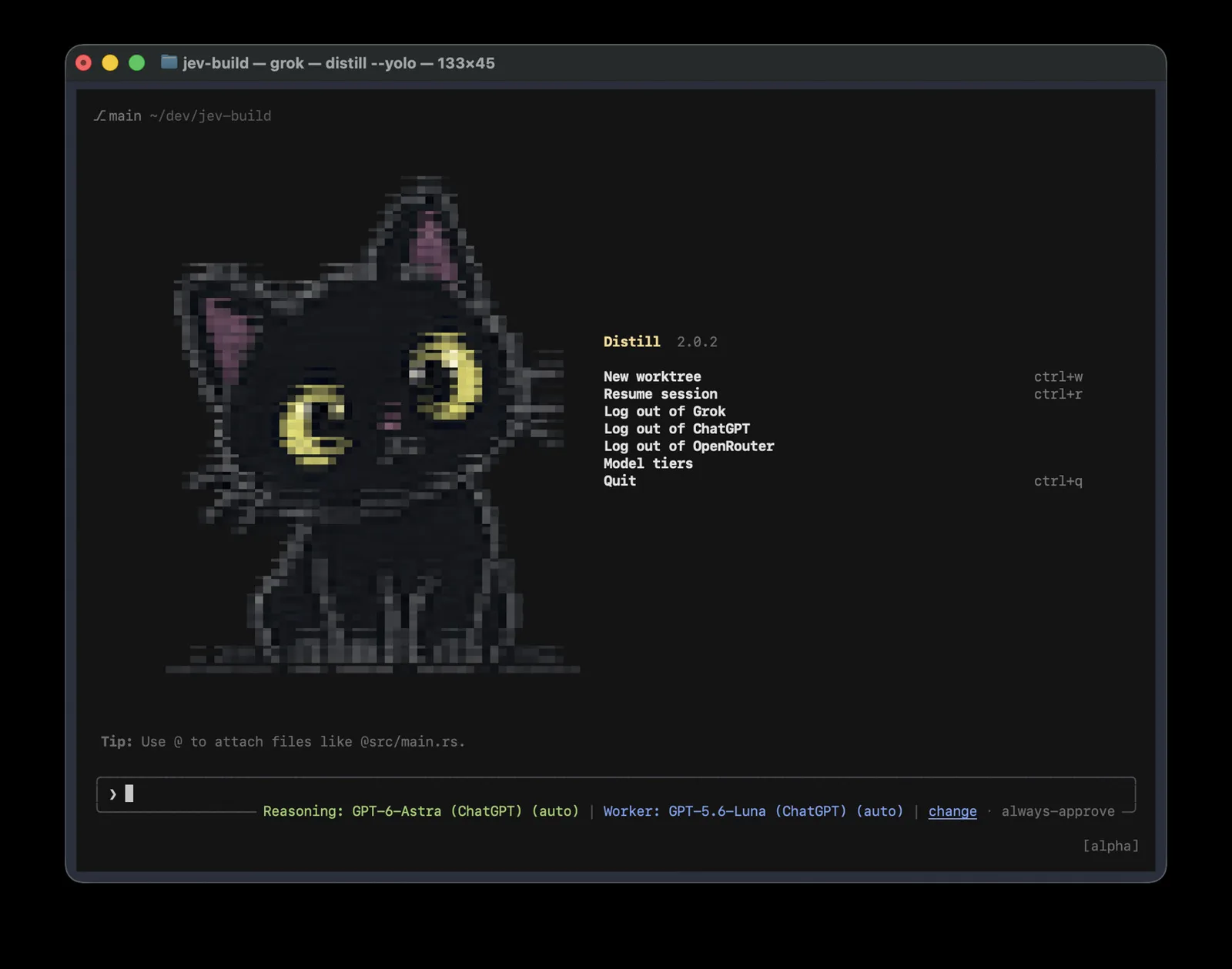
Model tiers
Each tier has its own picker. Every tier defaults to auto.
Handles the main conversation, the difficult reasoning, and the code changes.
/model or /tiers reasoning
Takes suitable calls in the same conversation when a lighter model can handle them. Optional.
/worker-model or /tiers worker
Handles bounded tasks such as extraction, summaries, and compression.
/utility-model or /tiers utility
Leave a tier unset to run without it. A Worker left unset means no Worker routing.
Routing
Jev is the decision layer inside Distill. It answers structured questions about a small state that the harness assembles: which model should take a call, how much effort that call needs, and which parts of a tool result are worth keeping.
Token saver
Most of the reduction happens in deterministic code, on a tool result, before it enters the conversation. A tool result meets these stages in order, and each stage has a guard that can stop it.
| Stage | What it removes | Runs when | Default |
|---|---|---|---|
| Read reuse | A second copy of bytes already in the conversation | 2000 bytes or more, and hash-identical to a payload already sent | On |
| Exact-output guard | Nothing. This stage stops the rest. | The call is line-addressed, or the text belongs to a skill | Always |
| Preclean | Terminal noise, and content the payload itself repeats | 2000 bytes or more, and not a document | On |
| Importance extraction | The unreadable middle of a long payload | 4000 bytes or more, and not a document | On |
| Utility task | A payload a small model can digest more cheaply than the session model should | 2000 bytes or more, and a task is registered for that shape | On |
| Utility compression | The same, for a payload too large to want whole | 24 KiB or more | On |
The first four stages save tokens. The last two save money by handing work to a cheaper model, which is a different thing.
Guards
Every stage that would drop bytes writes the original to a file first and sends its path along with the reduced text. A store that refuses means the stage does not run.
A reduction is compared against the original before anyone uses it. If a path, a file:line, a number, or an error word would disappear, the reduction is thrown away and the original bytes are kept.
retrieve_range returns a line range of a stored payload. grep_handle runs an exact match inside one and returns verbatim lines with their line numbers.
Distill uses a utility answer only when a guard can check it. An extraction must quote spans that really appear in the payload, a classification must land on a closed label, and a pick must name ids that were offered. When a check fails, the bytes stay as they were.
Rules
These are rules in the code, not settings.
A cap is not a saving, an estimate is not a measurement, and a skipped payload is not a win.
The harness
Distill is a full coding agent. The token saver is one part of it.
Sign in to Grok, ChatGPT, and OpenRouter independently. Signing out of one leaves the others alone.
Start an OpenAI-compatible server, add an entry to config.toml, and use it as any tier.
Open Model tiers from the home screen to change a tier, or type /tiers with the tier name.
/context shows where the window is going, including what tool definitions and skill listings cost. /compact reclaims space on demand.
GROK_LOG_JEV=1 records the lever, the verdict, the reason, and the confidence for every decision.
Set [jev] enabled = false, or start with GROK_JEV=0, to turn the whole layer off. Each lever also has its own key.
New profiles live in ~/.distill. Point DISTILL_HOME elsewhere, and an existing ~/.grok profile keeps working.
distill update upgrades an installation made with the release installer.
New worktree, resume session, model tiers, and a separate logout per provider, all on one screen.
Quick start
The installer detects your platform and architecture, then writes the binary under your home directory.
Run the command for your platform.
Log in to the subscription you already pay for, or to OpenRouter. You can use more than one.
Pick a Reasoning, a Worker, and a Utility model, or leave them on auto.
Start distill in any project directory.
macOS and Linux
curl -fsSL https://raw.githubusercontent.com/samuelfaj/distill/main/install.sh | shWindows
irm https://raw.githubusercontent.com/samuelfaj/distill/main/install.ps1 | iexUpgrade an existing install
distill updateQuestions
Any one of them. Distill keeps separate login and logout actions for Grok, ChatGPT, and OpenRouter, and signing out of one does not sign out of the others. ChatGPT uses OAuth, and OpenRouter accepts a browser login or an OPENROUTER_API_KEY.
Yes. Start an OpenAI-compatible server, add an entry to config.toml with the model id and the base URL, then select it as a tier. New profiles use ~/.distill, and you can move that location with DISTILL_HOME.
No. Jev picks among candidate models and routes that code supplies. Plan mode, auto approval, YOLO, and permission policies belong to Distill, and Jev cannot approve a call, veto one, or hold one for confirmation.
The harness falls back. A routing decision that fails, times out, or lacks confidence leaves the session model in place, and a utility answer that fails its guard is discarded so the original bytes stay as they were.
Start Distill with GROK_LOG_JEV=1. It writes logs/jev.jsonl inside your profile, one entry per decision, using labels such as reuse, crush, extract, keep, used, defer, local, and cloud.
Distill does not publish a savings figure, and the code does not measure one. The stages and their thresholds are documented, so you can read what runs and check the decision log from your own sessions.
Distill supports macOS, Linux, and Windows, and upgrades in place.
curl -fsSL https://raw.githubusercontent.com/samuelfaj/distill/main/install.sh | sh
Open source under the Apache-2.0 license.