
The owner loses an afternoon combining spreadsheet data. A small change stalls because only one person understands the system. Customer support promises an answer that depends on three tools and an old conversation.
At that point, it is easy to say, "We need to hire a developer." Sometimes that is right. Often, the problem is not a lack of code yet. It is an undefined process, an unclear decision, or nobody responsible for the software after the project ends.
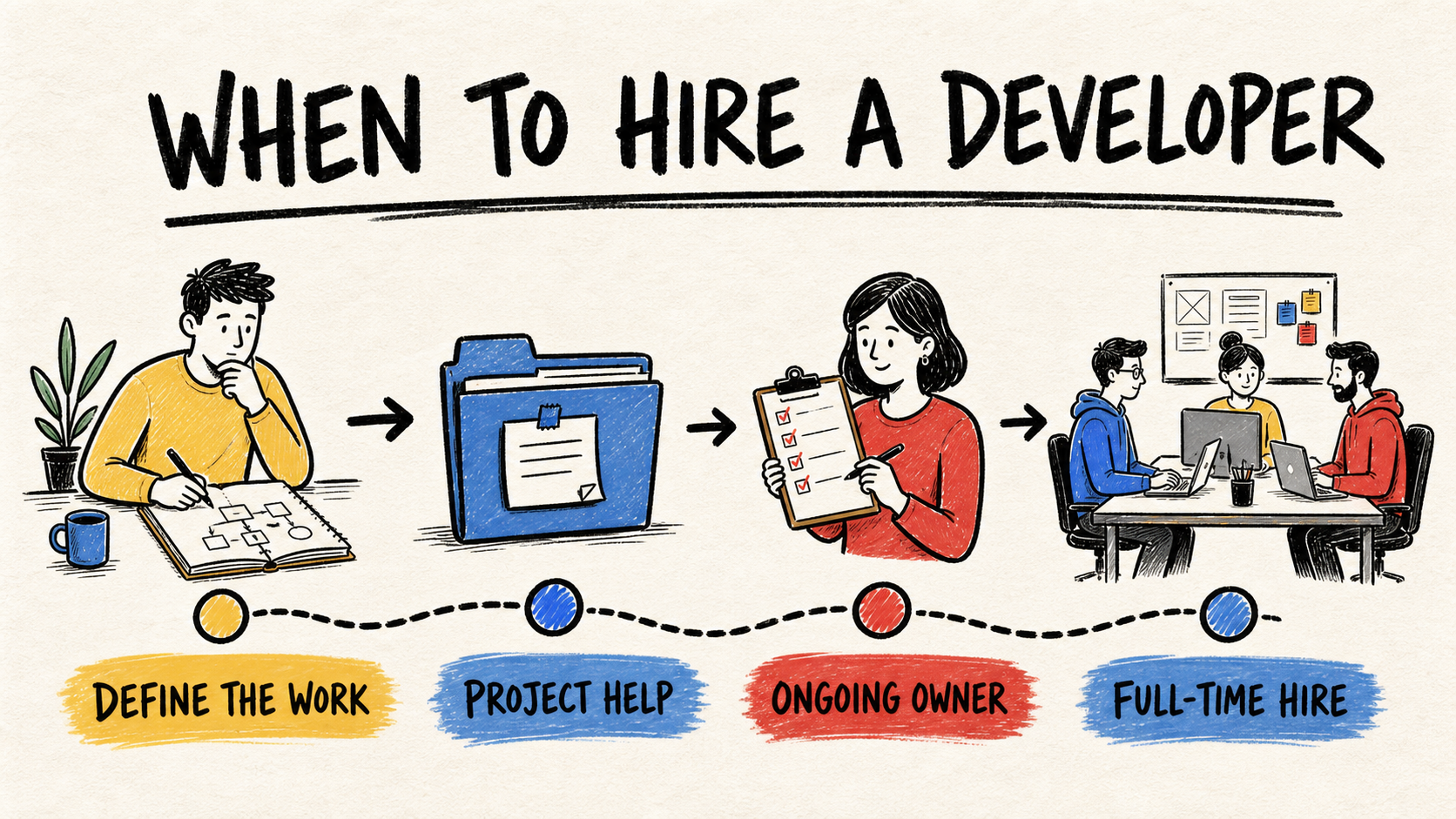
The practical rule is simple: hire development when there is recurring work, real operational impact, and authority for someone to decide what happens next. If the need is narrow, start with a project. If the work is continuous but less than a full-time role, consider ongoing responsibility for the software running the business. A full-time employee is one option, not the starting point.
The short answer
- Do not turn a vague frustration into a job description before you understand the work.
- Describe the workflow, recurring effort, risk, and decision that needs an owner.
- Use a project for a defined delivery, ongoing responsibility for a steady queue, and full-time hiring for a real continuing function.
- Any model should leave the business in control of its accounts, data, access, documentation, and handoff.
What is making the business consider hiring?
The first signal is not the number of tools. It is the work people repeat to compensate for those tools. Look for orders copied between systems, numbers reconciled by hand, the same question answered repeatedly, or a change that waits for one person.
Write down five recent situations. For each one, record what someone tried to do, where the flow stopped, who had to intervene, and what followed. You may find a missing integration. You may also find a business rule nobody defined or an approval with no owner.
Hiring a developer before writing this down creates a role that is hard to evaluate. The business asks for "system improvements" but cannot explain which result should change, which decisions belong to the role, or how to know the work is complete.
The useful test is to separate the pain from the work that must exist. "The system is bad" is an opinion. "Every morning someone combines orders from three places to know what can be billed" describes a responsibility that can be investigated, prioritized, and assigned.
Is the problem the process, the tool, or the missing owner?
Before opening a role, classify the problem. If the process changes every week, a developer may only automate confusion. If the current tool already does what the team needs, configuration or training may be enough. If systems do not share data, start with the diagnosis of business systems that do not talk, not an immediate hire.
Ask these questions:
- Can the team explain the workflow from beginning to end?
- Is there someone who can choose priorities and accept a change?
- Can the expected result fit in one sentence an operator recognizes?
- Does the business know which data, accounts, and services support the flow?
- Will the problem still exist after the first fix?
If the answers are no, define the work before choosing a hiring model. The next step may be mapping the operation, configuring an existing product, or running a short discovery project. Hiring becomes safer when the role receives a problem it can observe, rather than dissatisfaction that changes name in every meeting.
When nobody can explain who decides the next step, the problem is responsibility. The guide to who maintains software after launch separates access, maintenance, context, and handoff. Here the question comes earlier: does the operation already need someone to take on that work continuously?
Which hiring model fits the business now?
If the specific question is whether one person or a team should deliver the software, read the freelancer versus agency comparison for small businesses before choosing.
There is no universal company size that determines the right model. The decision depends on the amount of work, the importance of the flow, the urgency, and the management capacity available.
| Model | Makes sense when | Risk to control |
|---|---|---|
| No developer yet | The problem is undefined or the current tool works with process and configuration | Paying for work before knowing what should change |
| Project with a freelancer or agency | There is a defined delivery with a beginning, end, and acceptance rule | Finishing with code but no maintenance or context |
| Fractional or embedded owner | There is a recurring queue, but it does not fill a full-time role | Confusing availability with responsibility and leaving priorities ownerless |
| Full-time developer | Software is central, work is steady, and someone can manage the role | Paying for a full-time schedule without enough work, direction, or support |
| Small team or department | Several continuous workstreams exist and the business can support product, engineering, and operations | Creating a structure larger than the business can govern |
A project is a good answer when the work can be described as a delivery. That could mean organizing order intake, connecting two sources, or preparing a customer lookup area. The agreement should state what will be delivered, who provides context, how the business validates it, and what happens afterward.
Ongoing responsibility fits when small decisions appear every week. The person does not need to do everything. They need to keep context, prioritize requests, track risks, explain changes, and make sure someone else can take over if the relationship ends.
Full-time employment belongs in the conversation when there is a continuing function that can occupy most of the role and someone can manage it. A developer alone does not replace product decisions, operational knowledge, review, support, or executive accountability.
When is the business ready for a full-time developer?
Look for four signals together: software supports a routine that cannot stop, changes continue after the first delivery, there is enough work for a stable schedule, and a leader can make decisions with the developer.
None of these signals needs a magic number. The point is repetition. If the business needs one integration this quarter and then expects no further changes, that looks like a project. If every new sales, inventory, billing, or support step creates software work, there is a continuing function to own.
Also assess the management work. The U.S. Small Business Administration, "Hire and manage employees", retrieved in 2026, includes deciding between an employee and an independent contractor, setting up pay, and deciding who manages the payroll system. That does not answer the technical choice, but it shows that a full-time hire creates management responsibilities beyond the job description.
If the business has nobody to provide context, remove blockers, and choose priorities, a faster hire will not solve the problem. Consider part-time technical leadership, an accountable partner, or a bounded discovery first.
One question prevents a lot of wrong hires: "What will this person do in the week when there is no major feature to build?" The answer should include maintenance, support, documentation, small changes, and priority decisions. If it does not, the work is probably still a project.
How can outside help keep the business in control?
A small business can outsource work and still remain responsible for its own decisions. The National Institute of Standards and Technology, "Building Your Small Business' Cybersecurity Team: From In-House to Outsourcing", retrieved in 2026, recommends documenting objectives, obligations, assets, and dependencies before building a team. For providers, it says service levels, responsibilities, and expectations should be clear in a contract. It also says that outsourcing a need does not transfer the business's responsibility for protecting its data.
Before choosing a freelancer, agency, or ongoing partner, ask:
- What operational result comes first?
- Who inside the business chooses priorities and accepts the result?
- Does the business control the repository, accounts, domains, and data?
- How does the provider document changes and decisions?
- What support exists after delivery?
- How would someone else take over the work?
Be cautious with a proposal that only lists technologies, hours, and features. That does not show who understands the operation, who answers for a failure, or how the business can change providers. A sound agreement explains what the partner does and which decisions remain with the business.
If you already have more than one proposal, use the guide to comparing software development proposals before choosing a provider.
The Federal Trade Commission, "Cybersecurity for Small Business", retrieved in 2026, recommends putting security expectations in contracts, defining how a provider handles data, and limiting access to what is needed for the time it is needed. Use that guidance when a proposal touches customers, payments, orders, employees, or internal data.
What should be defined before hiring?
Prepare one plain-language page before speaking with candidates. Explain the affected flow, the observable pain, the desired result, the constraints, who uses the system, and how the business will recognize improvement.
Then separate business decisions from technical decisions. The owner can decide that an order must be confirmed before production starts. The owner does not need to choose the architecture alone. The candidate should explain options, dependencies, risks, what can wait, and which information is still missing.
Include the part that often disappears from a proposal:
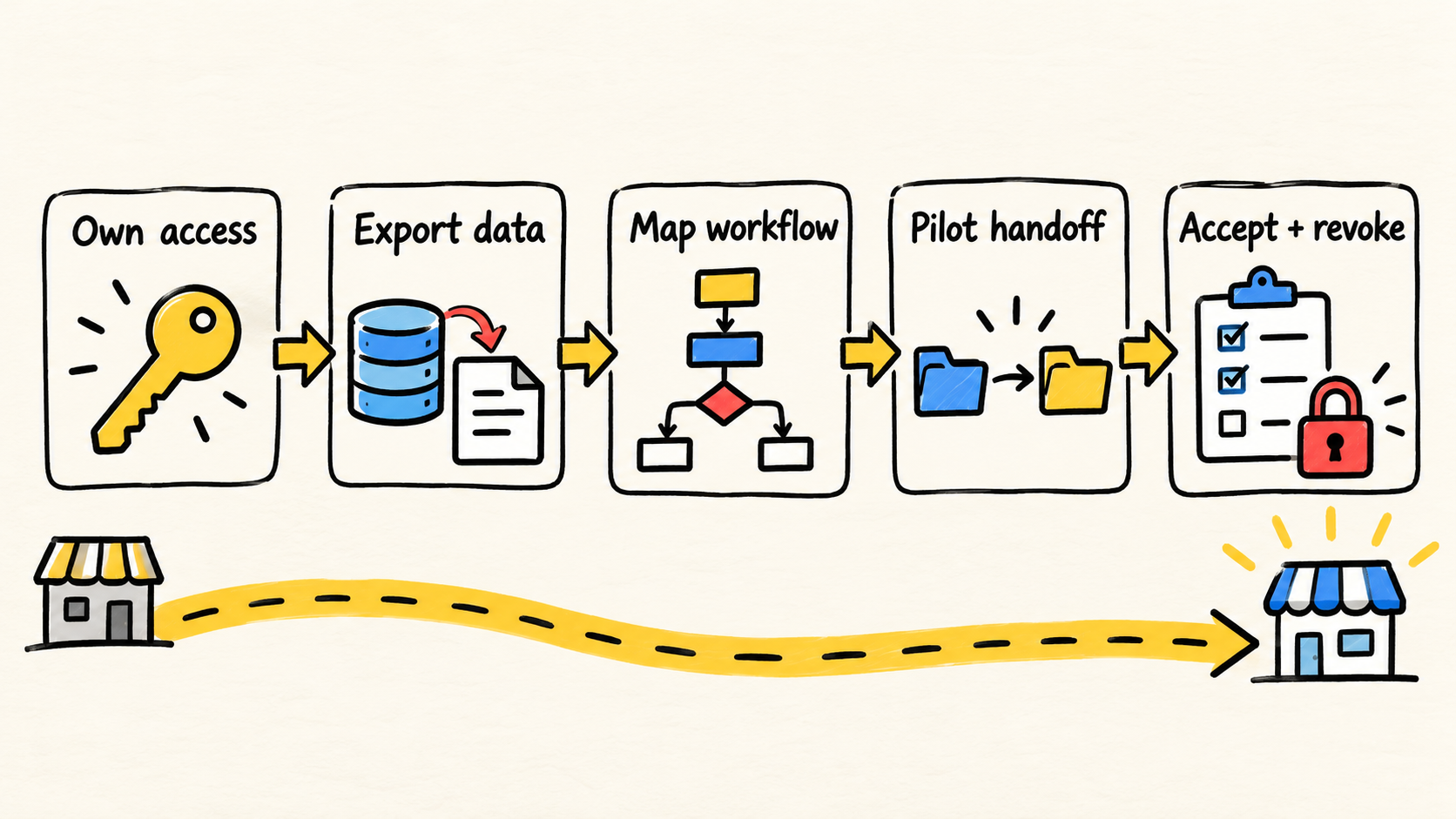
- accounts and access stay in the business's name;
- data can be exported in an understandable format;
- important changes leave a record;
- backups and restoration have an owner;
- support has a clear channel, response time, and limit;
- someone else can understand the operation;
- the agreement explains how the relationship ends.
If the work touches critical systems, list assets and dependencies before giving access. The FTC guide to vendor security recommends limited access, additional authentication when appropriate, and contract rules for handling data. That applies to an outside partner and a new employee.
How can a small business start without building a large team?
Start with the flow that holds back the business, not a platform that promises to solve everything. Describe the work, choose a small result, and name who will follow the change. Then choose the smallest model that can maintain that result safely.
If the problem is still unclear, run a short documented discovery. If there is a clear delivery, commission a project. If there is a recurring but variable queue, consider fractional or ongoing responsibility. If the work already fills a stable function and management is available, assess a full-time role.
This path also avoids buying another tool by reflex. Before hiring or building, use the checklist for deciding when to stop buying software tools. It helps separate a product problem from a process problem and identify who owns the result.
Frequently asked questions
Does a small business need a full-time developer?
Not necessarily. The work may be a project, a part-time role, or something a configuration can solve. Full-time hiring makes sense when software matters to the operation, changes continue, work is steady, and someone can guide and review the role.
Is it better to hire a freelancer or an agency?
It depends on the work. A freelancer may be enough for a small, well-defined delivery. An agency can help when several disciplines need coordination. In both cases, ask for business-controlled access, documentation, support, and a handoff that does not depend on one person.
Who should decide what the developer builds?
The business should define priorities, outcomes, and acceptable risk. The technical person should explain options, dependencies, and consequences. An ongoing owner can organize the conversation, but should not invent business rules alone. The decision is safer when operations and technical work review the same flow.
What if I cannot describe the problem technically?
You do not need to start with technology. Describe what happens today, who repeats the work, where information is lost, and which decision is stuck. A good professional turns that account into testable options. If a proposal cannot restate the problem in operational language, discovery is still missing.
If the problem began because the only person who understood the system left, read the checklist for taking over software without starting with a rewrite before opening a role.
Conclusion
A small business should hire a developer when it has a continuous, important, and well-defined software responsibility. That does not mean the first hire should be full time. The model may be a project, fractional help, an accountable partner, or an internal team, depending on the work and management capacity.
Before signing, answer five questions: which flow needs to change, what work repeats, who decides, who controls the systems, and how someone else would take over. If those answers do not exist yet, buy clarity before buying development. If they do exist and the queue never ends, there is a software responsibility decision to make.
Production note
Samuel Fajreldines is accountable for this article. The research used public guidance from NIST, the FTC, and the SBA, search results, and open discussions among operators. AI assistance helped with discovery, source comparison, first drafting, translation, image prompting, and consistency review. No client company was tested, and no private metric or case study was invented.
Sources
- National Institute of Standards and Technology, "Building Your Small Business' Cybersecurity Team: From In-House to Outsourcing", retrieved 2026-08-30, https://www.nist.gov/itl/smallbusinesscyber/guidance-topic/building-your-team
- Federal Trade Commission, "Cybersecurity for Small Business", retrieved 2026-08-30, https://www.ftc.gov/business-guidance/small-businesses/cybersecurity
- U.S. Small Business Administration, "Hire and manage employees", retrieved 2026-08-30, https://www.sba.gov/business-guide/manage-your-business/hire-manage-employees