
The owner knows an operating process is stuck, but does not know whether to call one person or a team. A freelancer's proposal looks simple. An agency's proposal looks safer. Then the practical questions arrive: who will do the work, who decides, and who stays involved after the project ends?
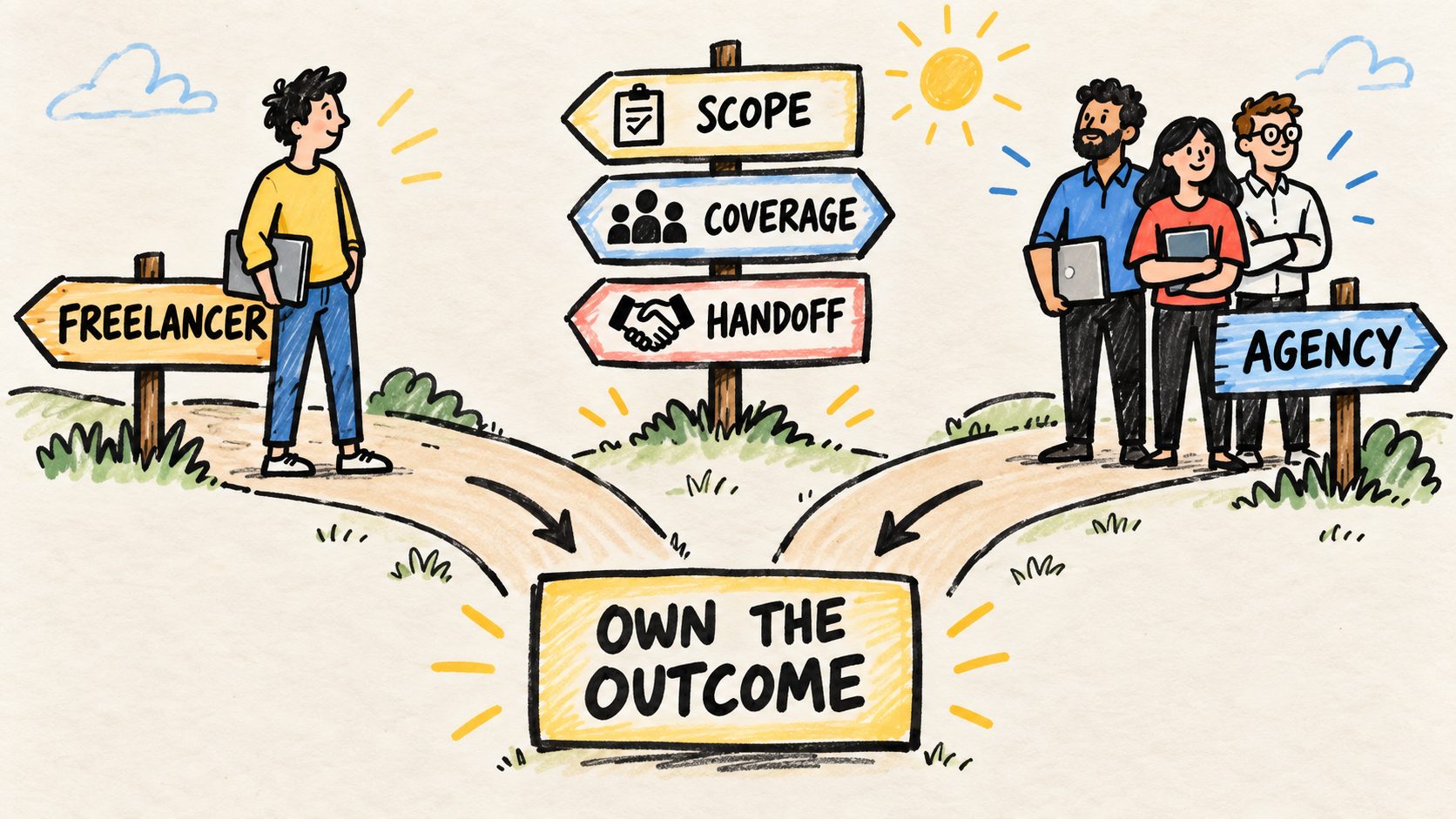
To choose between a freelancer and an agency for small-business software, start with the work that must exist, not the provider's label. A freelancer often fits a bounded delivery. An agency makes more sense when several skills must be coordinated or the business needs coverage. Either way, someone must own the outcome.
If the business does not yet have someone responsible for the software behind the operation, define that responsibility before hiring. Ongoing software ownership for the business is different from buying a one-time delivery. It includes context, priorities, access, maintenance, and a way for another person to take over.
The short answer
- Choose a freelancer when the problem fits a clear delivery and the business can provide context and decisions.
- Choose an agency when the work needs coordinated skills, coverage, or a delivery structure the business cannot organize alone.
- Choose neither before separating a confused process, a poor tool, and software that is genuinely needed.
- Keep accounts, data, acceptance criteria, documentation, and the transition plan under the business's control.
What is the business actually buying?
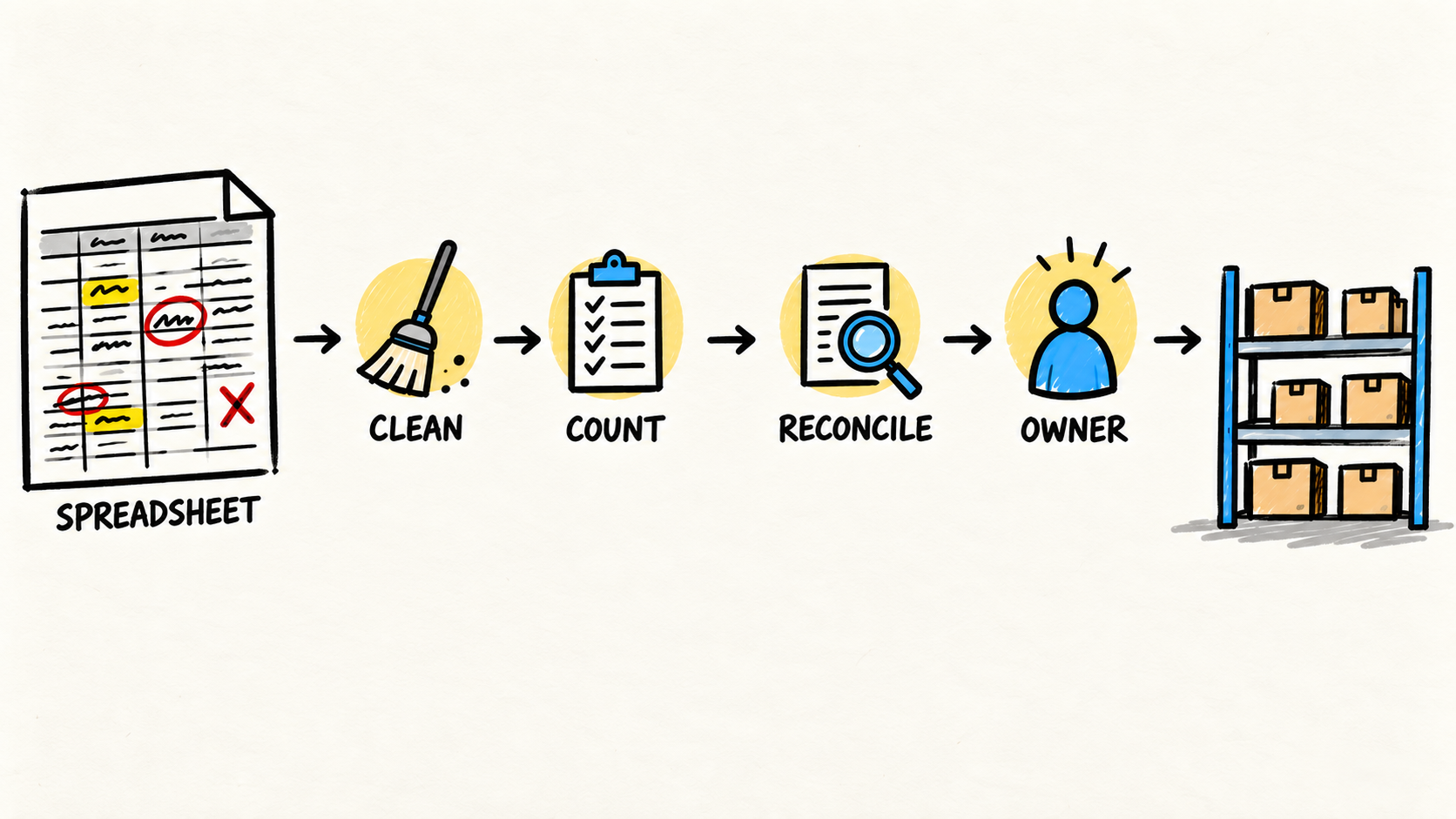
Before comparing providers, describe the result in operating language. "We need a better system" is not a purchase yet. "The team keeps copying each order between the form, finance, and inventory" describes a problem someone can investigate and accept.
Write down the affected workflow, who runs it, where it stops, which decision is waiting, and how the business will recognize improvement. If the work is organizing orders, connecting two tools, or giving customers a way to check status, say that. Do not start with the technology someone promised to use.
This step also separates a project from an ongoing responsibility. A project has a delivery and an end condition. A responsibility continues because new exceptions, rule changes, broken integrations, and improvement requests keep appearing. The guide on when a small business should hire a software developer helps make that distinction.
The useful question is not "who charges less?" It is "what happens in the week when nobody is building a new feature?" If the answer includes support, maintenance, documentation, and recurring decisions, the business is buying continuity, not only code.
When is a freelancer the better choice?
A freelancer is a good fit when one experienced person can lead the delivery without building a parallel team. That often means a bounded problem, few dependencies, and someone at the business who can explain the process and check the result.
Direct contact can shorten the distance between a question and a decision. It also makes a small delivery easier to adjust when the context is clear. But simplicity has a limit: one person cannot replace several skills just because a proposal uses phrases such as "complete solution."
Before hiring, confirm:
- who will do the work and which parts will be subcontracted;
- what result will be delivered and how the business will accept it;
- what experience exists with the process involved;
- which hours and channels exist for questions and incidents;
- where the code, data, accounts, and documentation will live;
- how someone else would take over if the freelancer became unavailable.
The main risk is not that a freelancer is one person. It is that the business turns that person into the only memory of the process. If knowledge stays in private conversations, access sits in personal accounts, or nobody can review the result, a low quote can hide an expensive dependency.
When is an agency worth the coordination?
An agency can fit when the project needs several specialties at once, such as product, design, development, testing, and delivery management. It can also help when the business needs coverage and cannot coordinate separate professionals itself.
That structure is not automatically better. The business should know who sold the work, who will do each part, who decides when trade-offs appear, and who answers for a failure. An agency that offers one sales meeting and a rotating intermediary has not solved the ownership problem.
Ask before signing:
- which people will work on the project from the start;
- what the agency does itself and what it passes to others;
- who owns decisions and incidents;
- how the agency records context, changes, and acceptance criteria;
- what support exists after delivery;
- how the business can reduce, pause, or end the work.
In a recent discussion among small-business owners about freelancers and agencies, the recurring objections were not only about price. People mentioned unclear coordination charges, changing contacts, freelancers disappearing, and the need to know who owns the outcome (r/smallbusiness discussion, retrieved October 4, 2026). That is evidence about language and objections, not an independent quality measurement.
When is neither option the right decision?
Do not hire development to compensate for a process nobody has explained. If each department describes a different workflow, the current tool already supports the needed function, or nobody can accept the change, the first task may be discovery, configuration, or operational cleanup.
Do not hire an agency for an adjustment one person can safely deliver. Extra structure creates meetings and decisions that do not improve the result. On the other hand, do not give one person a project that needs several workstreams, ongoing support, and availability they cannot provide.
The guide to when a small business should stop buying software tools helps separate another software purchase from a process problem. If you already have several proposals, use the guide to comparing software development proposals before signing.
The provider's size matters less than the size of the responsibility. A freelancer can support an important operation when coverage and documentation exist. An agency can fail on a small project when nobody can explain the workflow or accept the result.
How should you compare a freelancer and an agency?
Compare every proposal with the same questions. A simple table shows what you are actually buying:
| Question | Freelancer | Agency |
|---|---|---|
| Is the work a one-time delivery? | Often fits when the scope is clear | Can fit, but coordination must appear in the proposal |
| Does the project need several specialties? | The business must coordinate or hire others | The agency can coordinate if it names the accountable person |
| Does the business need coverage? | Require explicit backup and documentation | Coverage may exist, but confirm who is actually available |
| Who decides priorities? | A business owner and a technical contact should be named | An agency owner and a business decision-maker should be named |
| What happens after delivery? | Agree on support, documentation, and handoff | Agree on support, documentation, data, and exit |
Do not turn the table into a contest of adjectives. Give both providers the same situation: "What will you do if the result depends on a business rule that has not been defined?" The answer shows whether the provider understands discovery, risk, and decisions, or only knows how to list features.
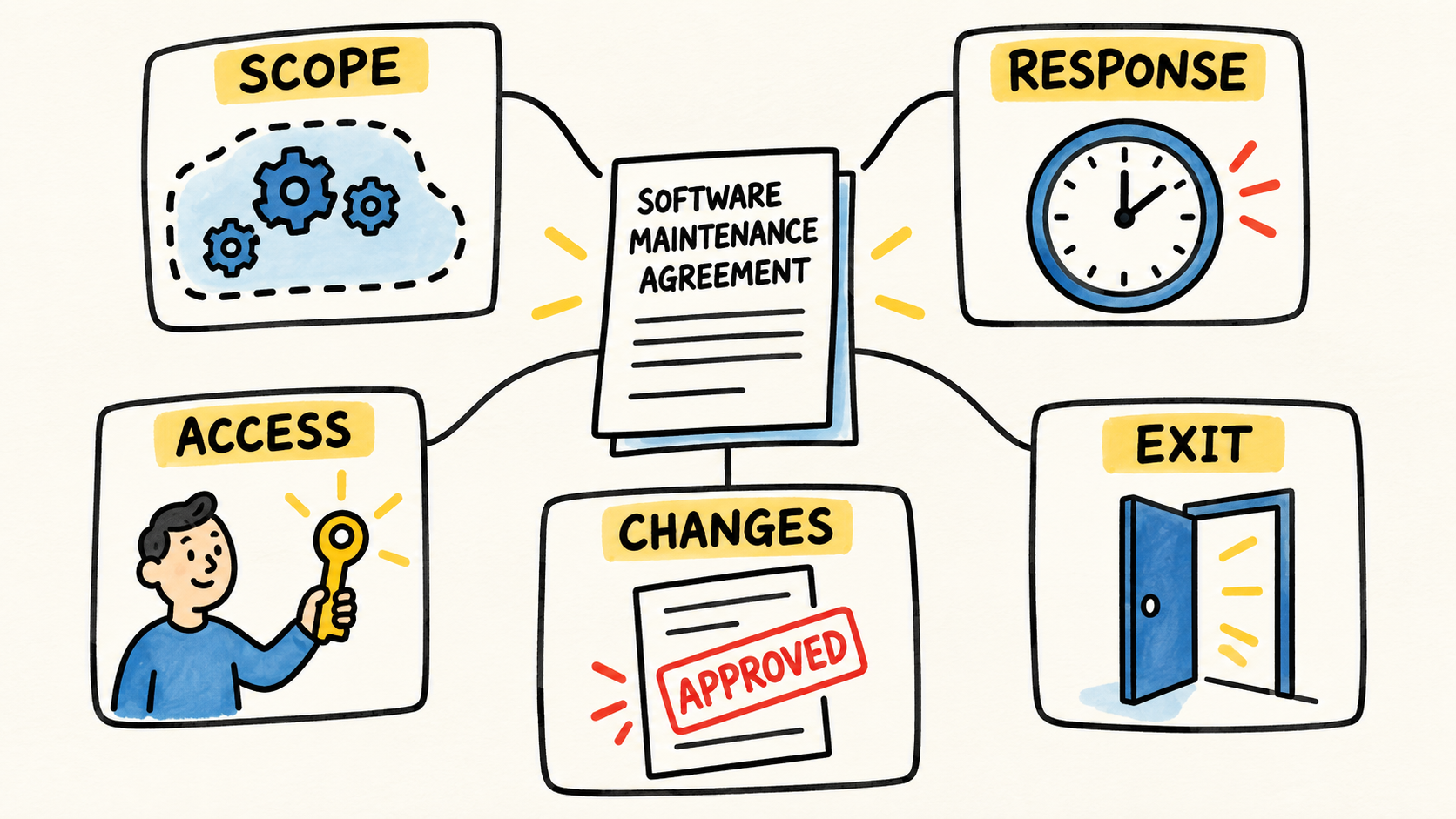
The guide to what a software maintenance agreement should include covers what happens after delivery. Use it to separate maintenance, new work, access, response, and exit. A proposal that leaves this boundary vague forces the business to negotiate under pressure after something breaks.
How do you keep control after hiring?
A business can hire outside help without handing over control of the business. NIST's "Building Your Small Business's Cybersecurity Team: From In-House to Outsourcing" tells small businesses to define outcomes, responsibilities, and expectations in a contract. It also makes clear that outsourcing a task does not transfer responsibility for protecting the business and its data.
For a software engagement, keep the main accounts in the business's name, limit access to what is needed, and record decisions that affect the operation. The FTC's "Cybersecurity for Small Business" recommends putting security and data-handling rules into vendor contracts and checking that vendors follow them.
Control does not mean the owner has to review code. It means the business can answer simple questions:
- where the data lives and who can access it;
- what result was agreed;
- who approves a change;
- how the delivery is checked;
- where the documentation lives;
- how another professional would take over.
If the choice is an internal employee, that is a different decision from hiring a vendor. The U.S. Small Business Administration's "Hire and manage employees" guide says small businesses should distinguish employees from independent contractors and consider the management and payroll obligations. Do not treat that distinction as a simple price variation.
Frequently asked questions
Is a freelancer always cheaper than an agency?
Do not use that as a rule. A freelancer may involve less coordination for a small delivery, while an agency may provide skills and coverage the business would otherwise have to organize. Compare the result, accountability, support, and transition cost, not only the quote.
Does an agency guarantee that the software will keep working?
No. An agency can offer a support structure, but continuity depends on scope, people, access, documentation, response, and exit. Ask how it handles a failure after delivery and who decides when a support request becomes a new project.
When should I choose ongoing support instead of a project?
Choose ongoing support when the software participates in weekly operations, changes keep appearing, and someone must prioritize work, track risks, and keep context. That does not require an internal team. It may require a clearly contracted ongoing responsibility instead of isolated projects that end without an owner.
What should I ask before choosing a provider?
Ask for the result, the people doing the work, dependencies, acceptance criteria, ownership of accounts and data, post-delivery support, and the handoff plan. If the proposal only lists technology and hours, the conversation about the business is still missing.
Conclusion
A freelancer and an agency are delivery models, not guarantees of an outcome. A freelancer often fits a bounded problem that one person can lead. An agency can fit work that needs several skills, coordination, or coverage. The decision becomes safer when those differences are explicit before signing.
Define the workflow, result, decision-maker, account owner, and handoff path. If those answers do not exist, buy clarity before buying development. If the work continues after the first delivery, do not hide an ongoing ownership need inside a one-time project contract.
How this article was researched
Samuel Fajreldines is the accountable author. The research combined public guidance from NIST, the FTC, and the Small Business Administration, current search results, recent public discussions among small-business owners, and existing pages on this site. AI assistance supported discovery, source comparison, first drafting, image prompting, and consistency review. No client, price, timeline, or private outcome was invented.
Sources
- National Institute of Standards and Technology, "Building Your Small Business's Cybersecurity Team: From In-House to Outsourcing", retrieved October 4, 2026
- Federal Trade Commission, "Cybersecurity for Small Business", retrieved October 4, 2026
- U.S. Small Business Administration, "Hire and manage employees", retrieved October 4, 2026
- r/smallbusiness, "Which one actually delivers better results for small businesses? Agencies or Freelancers?", retrieved October 4, 2026