

You know the work is getting stuck, but you do not know what to bring to the first conversation with a developer or software company. Your team repeats data, loses requests, waits for answers, or relies on a spreadsheet that no longer matches the operation. The question is not which technology to buy first. It is what the business should prepare before hiring help without buying a vague promise.
Start with one page that describes the problem, a real case from start to finish, the result you expect, who can decide, and what must remain under the business's control. If the operation also needs accountable ongoing ownership for the business's software, include that question before comparing providers. A project can end while nobody knows who will handle the next change.
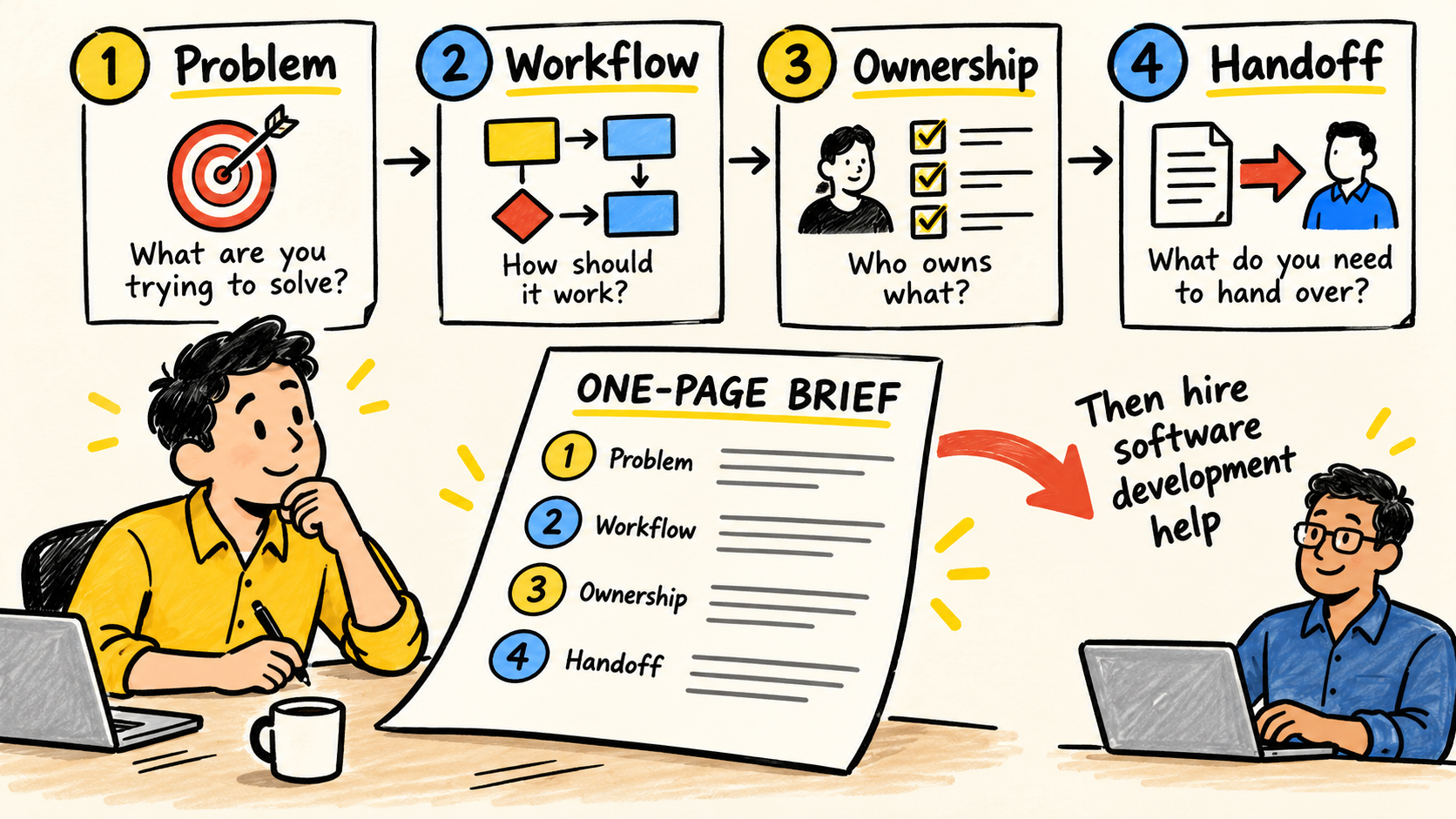
Short answer
- Describe a business problem, not a list of screens or technologies.
- Show a real case, including waits, copies, decisions, and exceptions.
- Name who approves the scope and who owns the result after delivery.
- Keep accounts, data, code, documentation, and exports under the business's control.
- Ask how the work will be reviewed, changed, delivered, and taken over by someone else.
What problem is the business trying to solve?
Before looking for help, write down what is happening in the operation. "We need a better system" is still an intention. A useful description says what work starts, where it gets stuck, and what result must exist for the business to accept the change.
Replace broad phrases with something observable. Instead of "improve sales," describe "record an approved order once and let finance find the same information without asking for another copy." Instead of "build a portal," describe the question customers keep asking and the status they need to see.
The U.S. Small Business Administration's guidance on managing a business recommends reviewing operations and paying attention to the data a business stores in cloud services. It does not choose a provider for you. It reinforces a useful preparation step: before hiring, know which part of the operation is under discussion and where the information lives.
If the problem still looks like a pile of complaints, do not ask for a fixed quote yet. Ask for help discovering the workflow or organize a small discovery step. A provider who has to guess the problem can deliver something technically complete and operationally useless.
Can you show one real case from start to finish?
Choose a recent order, support request, quote, or task and follow it all the way through. Note who starts it, what information arrives, where someone copies data, who decides, what waits, and how the team knows the case is finished.
Separate the normal path from exceptions. A common request may follow a simple rule, but missing information, a price change, or an approval outside business hours can change the whole flow. The goal is not a perfect specification. It is to show the difference between what happens most of the time and what needs human judgment.
The UK Department for Education's business process notation standard treats starts, ends, actors, decisions, tasks, and outcomes as visible parts of a process description. A small business does not need to adopt the formal notation. Use the idea as a hiring test: if you cannot draw who does what and what proves the end, the problem is not clear enough to commission.
Bring materials that make the case concrete: a sample spreadsheet without personal data, a form, a screen, an email, or a report. Do not hand over passwords in a first conversation. Show the work with safe data and explain which systems take part.
Who decides and who will own the result?
Define three responsibilities, even if one person holds all of them. Someone needs to explain the business priority, someone needs to confirm that the flow works day to day, and someone needs to respond when the software fails or needs to change.
The decision owner does not need to write code. They need authority to say what matters now, what can wait, and what result proves the first delivery worked. Without that person, a provider receives conflicting requests and the business loses its ability to recognize a good delivery.
The guide to who will maintain the software after launch covers access, maintenance, changes, and transition. Before hiring, the question is simpler: who gets called when the workflow stops next week? If the answer is "the developer, maybe," record the risk before signing.
When the business needs recurring help, compare that need with the decision about when to hire software help. When it needs one bounded delivery, the scope may be different. Do not confuse the hiring model with responsibility for the result.
What must remain under the business's control?
List the resources a provider will need to access and the resources the business must control. This usually includes the domain, hosting, code repository, third-party accounts, data, documentation, recovery keys, and records another person would need to take over.
The NIST guidance on identifying cybersecurity risks recommends listing business accounts, using separate accounts, and controlling who can access information. Use the same logic before hiring: each person should have the access needed for the work, important accounts should belong to the business, and a provider's departure should not erase the only copy of operational knowledge.
The GOV.UK guidance on managing technical lock-in recommends retaining ownership and access to data and considering the cost of leaving a relationship before it grows. It was written for public organizations, not as a private-business contract rule. The questions still help in any negotiation: what can you export, who controls the account, and how would someone else begin?
Do not grant unrestricted access because the business has not decided who should maintain the system. Start with business-owned accounts, proportionate permissions, and a simple record of who can change what. If a provider will not explain ownership of materials, account recovery, or handoff, that is information about the relationship, not merely a technical detail.
What should every candidate explain?
Take the same questions to every conversation. You do not need to test the candidate's technical skill yourself. You need to learn whether they understand the problem, can show the work, and have a clear way to continue after the first delivery ends.
- Who will do the work day to day, and who handles difficult decisions?
- How would you turn this real case into a small first delivery?
- How will we see working software before calling the work finished?
- What happens when the rule changes or an exception appears?
- Who tests the normal path, and who checks the business effect?
- Where will the accounts, data, code, and documentation live during the work?
- What is included after delivery, and how will a new change be agreed?
- How could someone else take over if the relationship ends?
An answer does not need to promise that everything will be simple. It should show where uncertainty exists and what the next step will do to reduce it. Be cautious when a conversation starts with technology, price, or a fixed deadline before anyone asks how the operation works.
Once answers arrive, use the checklist for comparing software development proposals before signing. Proposal comparison comes later. This page exists so you do not ask three providers for three different answers to three problems that were never described the same way.
When is the business ready to request a proposal?
You are ready to discuss a proposal when you can provide one page with the problem, a real case, the expected result, known exceptions, the decision owner, and access boundaries. You should also know what the first delivery will not attempt to solve.
Pause and prepare more when:
- each person describes a different process;
- nobody knows which system or file contains the correct information;
- the result depends on a rule that is still being debated;
- the business cannot say who approves changes;
- the provider needs to create accounts in their own name to begin;
- the request says "do everything" without a first case that can be checked.
If the main question is whether to choose one person or a team, see how to compare a freelancer and an agency for a small business. That choice is easier after the work, follow-up capacity, and continuity responsibility are visible.
Checklist for the first conversation
Before requesting a proposal, check whether you can answer:
- What business problem should change?
- What real case shows the problem?
- How does the normal path end?
- Which exceptions must stay with a person?
- What result will be checked in the first delivery?
- Who decides, who uses the system, and who owns it afterward?
- Which accounts, data, and materials belong to the business?
- What must be exported or handed over if the relationship ends?
- What is outside the first scope?
This list is not a contract or a technical specification. It is a way to make the conversation honest. If you do not know an answer, turn the uncertainty into a discovery question instead of hiding it in a proposal.
Frequently asked questions
Do I need complete requirements before hiring?
No. You need to explain the problem, a real case, the expected result, and the constraints you already know. A good partner can help discover details, but the business still needs to set priorities, approve the result, and explain the exceptions that only appear in daily work.
Do I need to know which technology I want?
No. Start with the work, the data, and the result. Technology may be a provider decision, a constraint from an existing system, or a question to investigate. Choosing a tool before describing the workflow narrows the conversation and can turn a preference into a requirement without a reason.
Can I start with a small step?
Yes. A first step might map the workflow, verify an integration, fix a handoff, or deliver one part the team can check. Give it an exit condition and an owner. If the relationship continues, the business can choose the next step using what it learned.
Should the provider create the business accounts?
The business should retain ownership of important accounts, even when a provider helps configure them. Define permissions, recovery, export, and documentation before access is granted. A provider can operate an account without owning it. That distinction protects continuity when the relationship changes.
Conclusion
Before hiring a developer, prepare the work you want them to understand. Describe a business problem, follow a real case, separate exceptions, name who decides, and keep the business's accounts and data under its control.
You do not need the technical answer before the first conversation. You need to know what result you are trying to create and how to recognize a safe handoff to the next person. If the problem, workflow, or owner is still unclear, the next step is to organize the operation. If they are clear, you can compare help with a better question and less room for vague promises.
How this article was produced
Samuel Fajreldines is responsible for this article. The research combined current search results, public guidance from the U.S. Small Business Administration, NIST, and GOV.UK, plus public discussions from owners and operators. This is a decision-preparation synthesis. It contains no benchmark, measured savings, client test, or invented case study.
AI assistance supported source discovery, comparison, organization, first drafting, localization, image generation, and consistency review. It did not operate a client workflow, measure an outcome, interview a business owner, or supply experience the author has not demonstrated.
Sources consulted
- U.S. Small Business Administration, "Manage your business", consulted October 25, 2026.
- NIST, "How to Identify Your Company's Cybersecurity Risks", consulted October 25, 2026.
- GOV.UK, "Managing technical lock-in in the cloud", consulted October 25, 2026.
- GOV.UK, "How to assess a hosting business case", consulted October 25, 2026.