
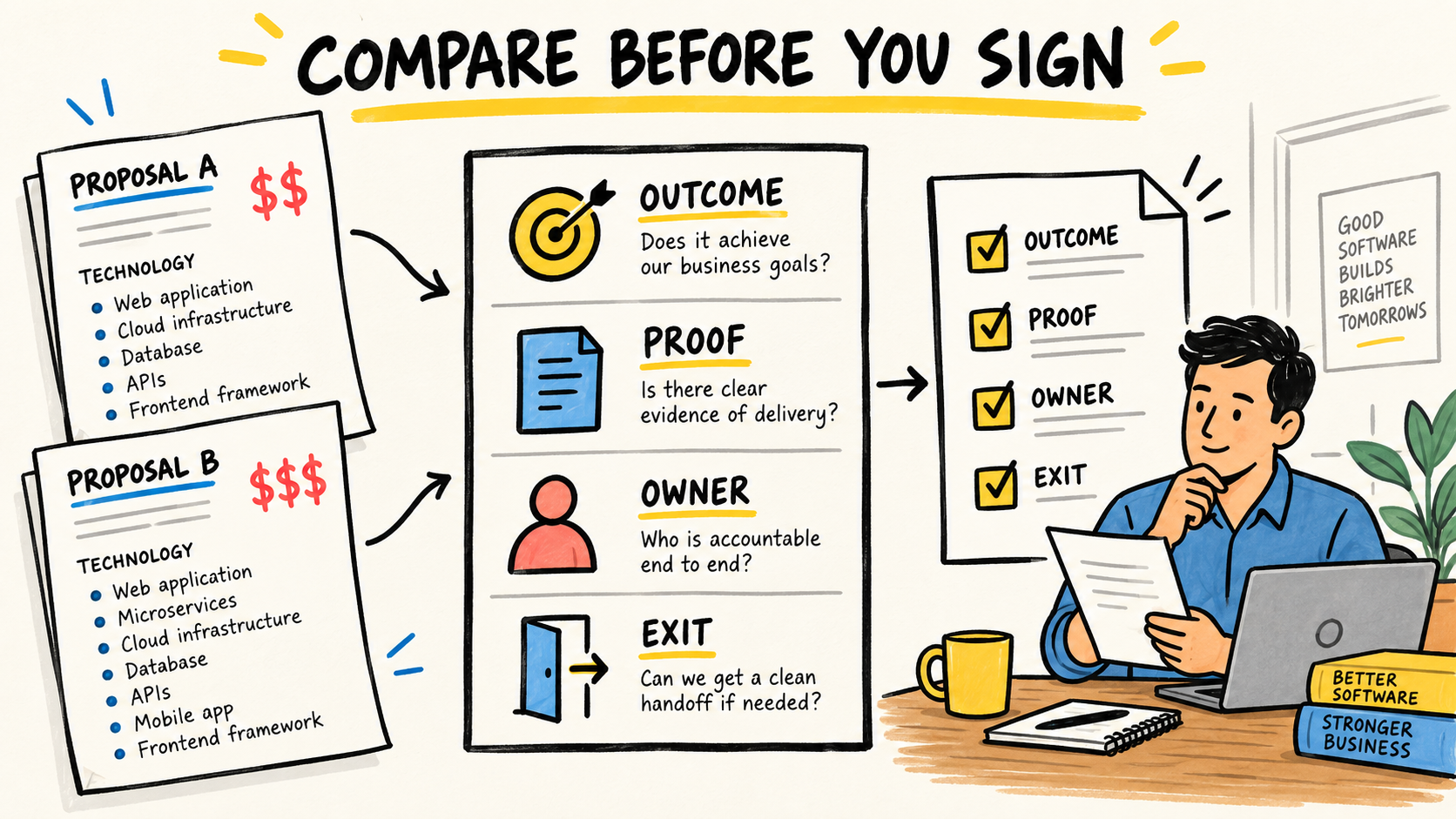
You have two proposals for the same business problem. One lists hours and technologies. The other promises an outcome without saying how anyone will accept the work. The totals may look comparable. The work hidden behind each document is not.
Start with the result the business needs to observe. Then put every proposal in the same frame: what is included, what is excluded, how delivery will be proved, who makes decisions during the work, and what remains after launch.
If the operation needs ongoing ownership for its business software, include that responsibility in the comparison from the beginning. A lower quote can become expensive when nobody knows who maintains access, handles a failure, or answers for the next change.
The short answer
- Rewrite each proposal as a business result an operator can recognize.
- Compare assumptions, boundaries, milestones, and acceptance evidence before looking at the total.
- Ask how the work will be delivered, tested, and handed over.
- Confirm who controls the accounts, data, code, and decisions.
- Compare prices only after the work is equivalent.
Why do different proposals sound like the same project?
One proposal may describe screens, integrations, and hours. Another may describe only the desired outcome. Neither format proves that the provider understands the same job.
Write one sentence without technology, such as: "The sales team should record an order once and follow its status until billing." Then list what must be true for that sentence to work: who uses the process, what data enters, who approves exceptions, which system is authoritative, and how the business will confirm the result.
This preparation also prevents a buyer from hiring before deciding whether the need is a one-time project, a continuing queue, or an internal function. The guide to when a small business should hire a software developer covers that earlier decision. This article starts later, when proposals are already in hand.
What should be put on the same line before comparing price?
Create one comparison sheet for each proposal. It does not need to become a formal request for proposal. It needs to make omissions visible.
| Criterion | Question for every provider | Evidence to request |
|---|---|---|
| Outcome | What will change in the operation? | A workflow described in business language |
| Scope | What is included, excluded, or conditional? | An explicit delivery list and assumptions |
| Data and integrations | Which systems and information are involved? | A simple map of inputs, outputs, and owners |
| Delivery | How will we know a part is ready? | A demonstrable milestone and acceptance rule |
| Responsibility | Who decides, performs, reviews, and answers? | Named roles, channel, and check-in rhythm |
| Continuity | Who maintains, changes, and takes over if needed? | Access, documentation, maintenance, and exit plan |
If a cell is blank, do not treat the gap as an administrative detail. It is a difference between proposals. Ask whether the item was forgotten, excluded, or left for discovery.
How can you tell whether the proposals promise the same result?
Turn every promise into a scenario an operator can recognize. A useful scenario has an input, a decision, and an observable outcome.
For example: "An order arrives with an item out of stock. Who gets the alert, who decides what happens, and where is the result recorded?" Ask every provider the same question. The comparison improves when each one explains the normal path and one exception.
Be cautious with phrases such as "complete system," "everything connected," or "simple experience" when they have no testable case behind them. You do not need to remove all commercial language. You need to learn what behavior it represents.
The diagnosis of business systems that do not talk to each other helps when the problem is copying data between sales, operations, and finance. Use it to describe the current failure before accepting a proposal that promises to "integrate everything."
What parts of a proposal show how the work will be delivered?
Price and schedule become meaningful only when the proposal explains how the work will move. Look for four signals:
- Observable milestones. Each stage should produce something the business can review, such as a workflow running in a test environment, a checked data import, or a screen connected to example data.
- Acceptance criteria. The proposal should say what must happen for a delivery to be accepted and who confirms it.
- Change handling. Ask what happens when a rule changes, an integration cannot provide an expected value, or a user finds an exception.
- Decision records. Find out where choices, open questions, risks, and scope changes live. A meeting that exists only in someone's memory cannot protect the comparison.
A proposal may use a fixed price, hourly billing, or another commercial model. The model does not replace acceptance criteria. In every model, you need to know what will be demonstrated, what depends on your business, and how a change alters the agreement.
What should you ask about the people doing the work?
The company name in the header does not tell you who will speak with the operation or make technical decisions. Ask:
- who will discover the current process;
- who is the contact for questions and decisions;
- who reviews work before delivery;
- which parts will be done by other suppliers;
- how the business will be told when the responsible person changes;
- who handles maintenance and incidents after delivery.
A freelancer can be right for a bounded problem. An agency can help when a delivery needs several skills coordinated. An ongoing owner may fit when software participates in the daily operation and changes with the business. The label does not settle the decision. The proposal should reveal the continuity you are buying.
The guide to who maintains custom software after launch separates control, maintenance, context, and handoff. Use those four questions to test a proposal before the dependency becomes a surprise.
Who should control accounts, data, and code?
A provider can administer a service without being the only owner of the accounts that keep the operation running. Ask the proposal and contract to identify how the business will access its domain, hosting, repository, data, external services, and account recovery.
The Federal Trade Commission advises small businesses to put vendor security expectations in contracts, define how data may be used, and limit access to what a provider needs for the time it needs it. This is not a contract review, but it gives a buyer concrete questions to ask.
For code hosted on GitHub, the repository transfer documentation shows that changing the owner also affects issues, pull requests, settings, and other repository elements. It is one example of an exit question to understand. Transferring a repository does not transfer business data, services, credentials, documentation, or process knowledge by itself.
Do not try to settle intellectual property with a generic sentence. Ask what will be delivered, which third-party licenses exist, how the business can export its data, and what happens when the relationship ends. Ask a qualified professional in the relevant jurisdiction when the legal wording is unclear.
How should you compare a proposal without choosing the cheapest by reflex?
Take price out of the first pass. For every criterion, write what you understood and mark the answer clear, partial, or missing. Then ask every provider the same questions.
A price difference may come from smaller scope, different assumptions, more discovery work, or a different support arrangement. Do not conclude that the lowest quote is an opportunity or that the highest quote is safer. Find out what work each one actually includes.
Compare the cost of your own participation too. Who supplies data? Who tests the workflows? Who approves changes? Who answers user questions? A proposal that requires substantial internal time may still be right, but the business needs to see that commitment before it signs.
Before signing another software contract, check whether the problem calls for another tool or a clearer operating model. The diagnosis of when a small business should stop buying software tools helps separate a purchase, an integration, a process, and an ownership problem.
What should you test before choosing the provider?
Ask for a short conversation about one real case, without sharing sensitive data. Use a normal workflow, an exception, and a likely change. The conversation should show:
- what questions the provider asks before promising a solution;
- which parts of the proposal depend on information that is still missing;
- how the provider explains a choice between alternatives;
- what evidence will be shown before acceptance;
- how a decision that affects the operation will be recorded;
- how another person would find the context if the provider became unavailable.
The goal is not to turn a sales meeting into a programming exam. It is to check whether the proposal matches the problem, whether uncertainty is visible, and whether there is a way to correct course.
When should you ask for a revised proposal?
Ask for a revision before comparing when:
- the outcome appears only as a list of technologies;
- two proposals use different words for the same item and nobody explains why;
- the price depends on assumptions the business has not confirmed;
- there are no acceptance criteria or demonstrable milestones;
- post-launch maintenance is deferred to a future conversation;
- accounts, data, code, or documentation remain under the provider's exclusive control;
- the provider cannot describe a reasonable exit.
This does not prove that the proposal or provider is bad. It proves that you cannot compare the commitment yet. A clear answer, including one that points out a limitation or asks for discovery, is useful decision evidence.
Frequently asked questions
Should I choose the proposal with the lowest price?
Not before you normalize the work. Compare the result, scope boundaries, internal effort, acceptance criteria, maintenance, and exit. A smaller proposal may describe less work or rely on assumptions another provider made explicit. Price belongs in the decision after you know what each provider is actually offering.
Do I need to understand the technology to evaluate a proposal?
You need to understand how technology affects the operation, but you do not need to choose every tool yourself. Ask why an option fits the workflow, what risks it creates, what will be hard to change, and how another person would take over. If the answer only repeats tool names, the proposal has not yet been translated into a business decision.
What should happen after I choose a provider?
Record the expected result, assumptions, deliveries, acceptance, decision path, company access to accounts and data, change handling, maintenance, and handoff. The proposal may become part of the contract, but the documents should say which commitments apply. Ask a qualified professional about legal questions.
Conclusion
A software proposal is not comparable just because two pages show a price and a date. It becomes comparable when it describes the same result, makes assumptions visible, and shows how delivery will be accepted and maintained.
Before signing, ask every provider to walk through a real case and answer four questions: what changes in the operation, what proves delivery, who is responsible afterward, and how can the business leave if needed? If a proposal cannot answer, buy clarity before buying development.
Production note
Samuel Fajreldines is responsible for the editorial direction of this article. The research combined current search results, public guidance from the FTC, CISA, and GitHub, this site's software ownership pages, and public discussions among buyers and operators. No client proposal was audited, no savings were measured, and no case study was invented. AI assistance helped with research, source comparison, the first draft, the image, localization, and consistency checks. It did not provide legal advice or measure project results.
Sources
- Federal Trade Commission, "Cybersecurity for Small Business," retrieved 2026-09-13. The link appears in the access and security section.
- CISA, "Assisting Small and Medium-sized Businesses Assess Vendors and Suppliers Fact Sheet", retrieved 2026-09-13.
- GitHub Docs, "Transferring a repository," retrieved 2026-09-13. The link appears in the asset-control section.
- Routiine, "How to Evaluate a Software Development Proposal", retrieved 2026-09-13.
- VantaSoft, "How to Review a Software Development Proposal", retrieved 2026-09-13.
- SpeedInno, "How to Choose a Software Development Partner: A Buyer's Checklist", retrieved 2026-09-13.