
The current provider is slow to respond, the software depends on accounts nobody at the business controls, and changing vendors feels dangerous. The fear is larger than lost files. It includes losing customer history, breaking an integration, or finding out too late that the new provider cannot run the core workflow.
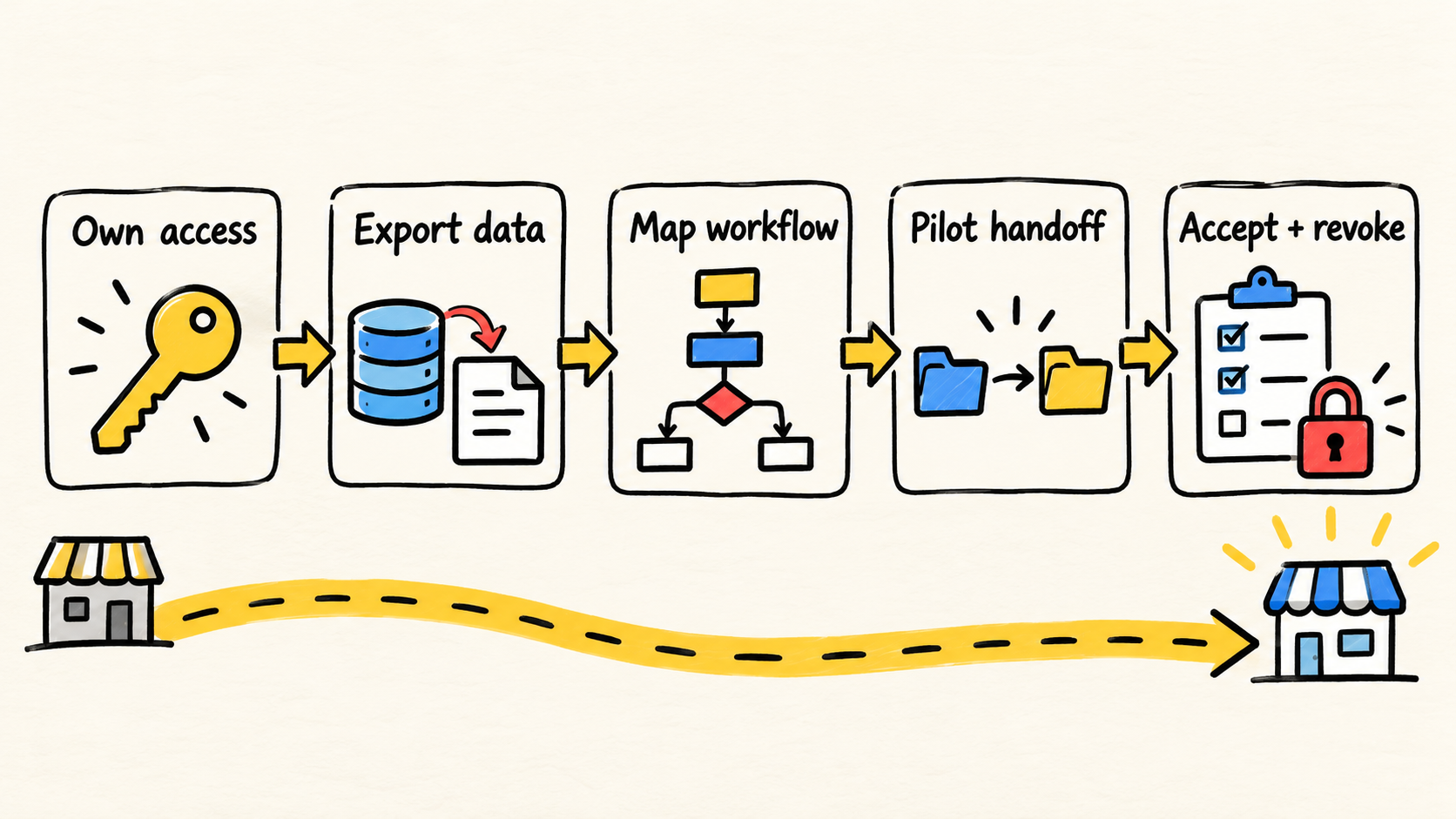
To switch software vendors without losing data, start before the termination notice. Secure access and exports, describe a real workflow, test a small handoff, and define what proves the new operation is ready. If nobody owns that continuity, ongoing ownership for the business software belongs in the decision.
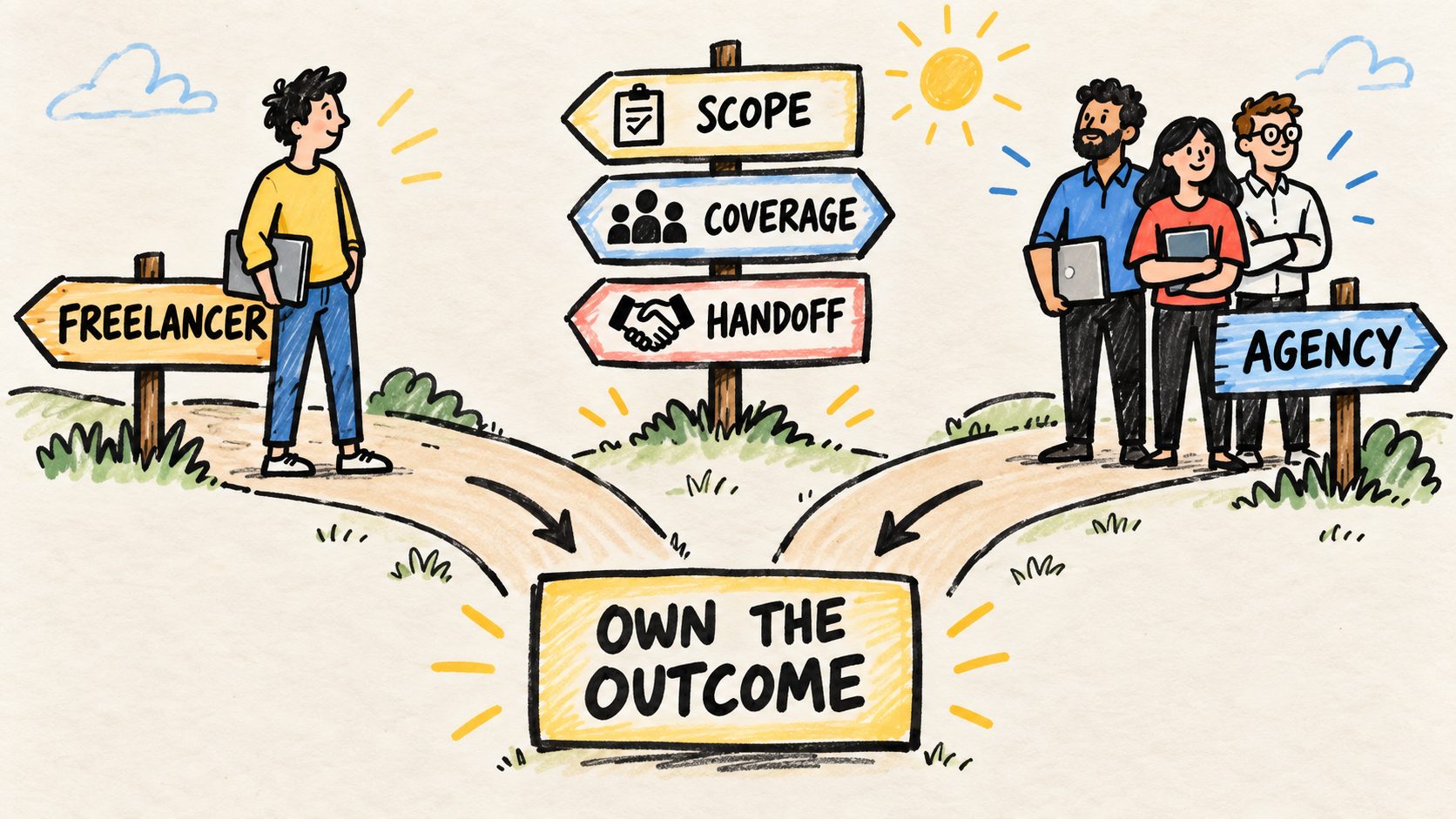
This is different from choosing a freelancer or agency for small-business software. Provider selection comes after the business knows what it must protect, transfer, and accept.
Short answer
- Control accounts, domains, data, integrations, and payments before announcing the exit.
- Inventory the work, rather than a list of screens and services.
- Export and check a representative sample before promising a full migration.
- Move in stages, with a real workflow and a rollback plan.
- Revoke old access only after acceptance and recovery steps are recorded.
The switch starts before the termination notice
Do not notify the current provider before you know what the business can recover. Save the contract, support tickets, renewal notices, domains, paid services, and the people who can access the environment.
Then ask four questions:
- Which accounts belong to the business, and which were created by the provider?
- What data can be exported today, in what format, and with what limits?
- Which parts of the process depend on code, configuration, spreadsheets, integrations, or one person's knowledge?
- What must keep working during the change?
The Federal Trade Commission's guidance on vendor security recommends putting data handling in writing, limiting access to what a vendor needs, and checking that the rules are followed. During a switch, that becomes a practical order: find out what exists and who controls it first, then define what will move.
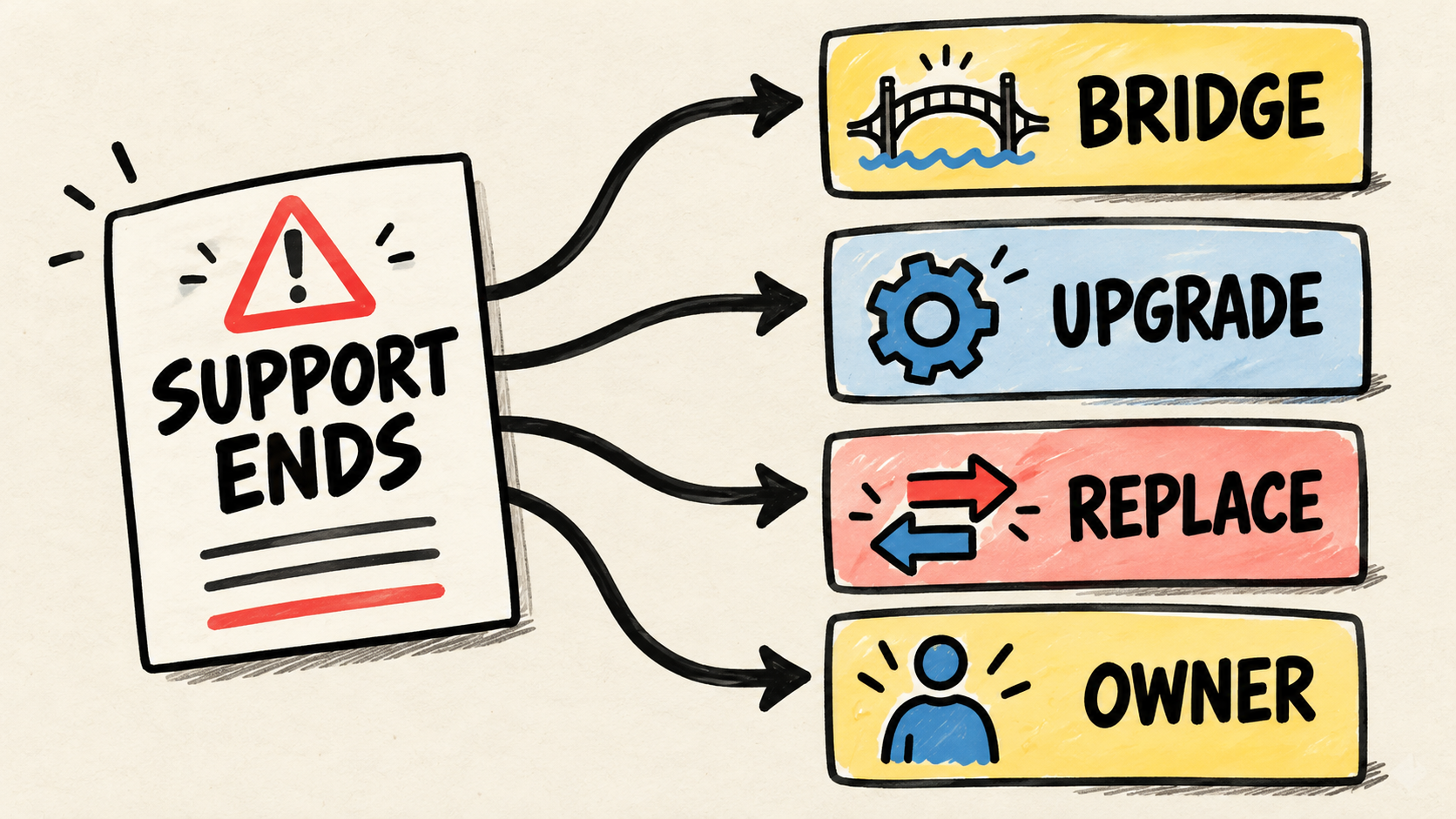
If the system has already lost support, the decision may be different. The guide to business software that loses support separates a bridge, an upgrade, a replacement, and a new owner. This article focuses on carrying out a planned provider change.
What should the business control?
A customer export is not enough if the business does not control the domain, payment provider, repository, integrations, or recovery account. Make a simple inventory and mark each item as "business-owned", "provider-managed", or "unknown".
Include:
- administrator accounts and recovery methods;
- domain, hosting, repository, and certificates;
- customer, order, billing, file, and history data;
- integrations, keys, webhooks, and scheduled jobs;
- recurring payments, licenses, and third-party contracts;
- process documentation, decisions, and recent changes;
- backups and instructions for restoring them;
- the people who approve changes and accept the result.
The FTC guidance for vendors, checked October 11, 2026, also recommends strong authentication, access controls, and contract terms for security and deletion. This does not turn a provider switch into a security audit. It does stop the business from ending the relationship without knowing who still has access or how to recover important information.
Do not ask for passwords in a message so someone can fix everything on the last day. Prefer business-owned accounts, individual invitations, access records, and credential rotation after the transfer.
How should the business verify data before migrating?
The new provider needs more than table names or a file format. It needs to understand which relationships and decisions the operation cannot lose.
Choose a small, representative set. It might include a customer, an edited order, a partial payment, an attachment, and an exception someone handles manually. Export the set, import it into a test environment, and compare:
- record counts and identifiers;
- relationships between customers, orders, items, and payments;
- dates, statuses, and fields staff use to make decisions;
- files, permissions, and history;
- external effects, such as a message, payment, or update in another system.
The ICAEW checklist for implementing software solutions raises questions about provider selection, data access, and dependence on a supplier. Use the same lens before a switch. A polished demo does not prove that history is exportable, relationships will survive, or staff can check the result.
Do not call a migration complete because a file opened. Record what was exported, what was left out, who checked it, and how a difference will be corrected. If the old system only provides part of the history, decide what must be migrated, what must remain searchable, and what can be archived.
How can the handoff avoid stopping the operation?
A switch is safer when the work is divided into stages that someone can accept. The new provider can start with a low-risk workflow while the business keeps the old path available for the period needed to compare results.
A possible sequence is:
- Map the main workflow and its exceptions.
- Create or confirm accounts controlled by the business.
- Export and check the sample.
- Reproduce the workflow in testing.
- Run a pilot with a limited operation.
- Compare the result, history, permissions, and external effects.
- Record acceptance, rollback steps, and the date for closing the old path.
The pilot does not promise that nothing will go wrong. It reveals what the new team does not understand yet. If a changed address, edited order, or partial payment changes the decision, that case belongs in validation.
The CodeFirst supplier transition plan organizes a handoff around responsibilities, milestones, and a first low-risk change. It is a process reference, not proof that one schedule fits every business. The work depends on the systems, contracts, and data involved.
When does the business need an ongoing owner?
Changing providers helps less if the business remains without someone who owns the context. After the handoff, someone must approve changes, follow failures, review access, check backups, and decide when a request is maintenance or a new project.
The guide to who maintains software after launch describes that responsibility. For this switch, ask a direct question: who will answer the week after cutover, when the first exception appears that was not in the demo?
A provider can take on that role, but the agreement should say how decisions are recorded, where data lives, how another person can access the environment, and what happens if the relationship ends. The business does not need to do the technical work alone. It does need to explain what remains its responsibility.
Before hiring, the guide to comparing software proposals before signing helps check scope, acceptance criteria, access, and continuity. For a switch, add the exit question: how will the next provider receive the system without starting with a blind investigation?
Mistakes that make a switch riskier
Announcing the exit before recovering accounts
If the current provider is the only administrator, the business may lose time when it most needs to export data and document the environment. Recover the control allowed by the contract before ending access.
Choosing the replacement from a demo
A demo shows an ideal path. The business also needs to test exceptions, history, and relationships between records. Choose the workflow that can be accepted, rather than just the screen that looks most complete.
Cutting off the old system after the first test
Keep a rollback plan while the result is unverified. That does not mean paying for two systems forever. It means defining the event that allows one of them to be shut down.
Confusing an export with recovery
A downloaded file is not a tested recovery. Someone needs to open it, relate it, and check the data the operation actually uses.
Changing the provider without changing responsibility
If nobody at the business approves decisions or understands the workflow, the new provider inherits the same context gap. A new contract does not create an owner.
Frequently asked questions
Should the business notify the current provider before hiring the new one?
There is no universal order because contracts and operational risks differ. Before the notice, confirm which accounts, data, documents, and access the business can recover. The new provider should be hired from a verifiable inventory, not from a promise to discover everything later.
How can the business tell whether data migrated correctly?
Choose representative cases and compare records, relationships, dates, statuses, attachments, and external effects. Record what was checked and who accepted it. The total count can match while an order, permission, or important history is attached to the wrong record.
Does every historical record need to be migrated?
Not necessarily. The decision depends on how the data is used, the business's obligations, the contract, and the available format. Separate data needed for operations, history that must remain searchable, and files that can be archived. Do not delete the old system until retention and recovery are confirmed.
Who should lead the switch?
Someone inside the business must own priorities, acceptance, and continuity even if a provider does the technical work. If that person or partner does not exist, define the responsibility before the migration starts. Otherwise each side may assume the other approved the next step.
Conclusion
A safe provider switch does not start with a termination email. It starts when the business knows which processes depend on the provider, controls the necessary accounts, can export the data, and has a way to check the result.
Move in stages, test a real workflow, record acceptance, and only then revoke the old provider's access. If nobody can own the decisions after cutover, the problem is larger than choosing another provider. The business also needs ongoing responsibility for the software that runs the operation.
How this article was produced
Samuel Fajreldines is the accountable author. The research combined current English, Portuguese, and Spanish search results, public operator signals, FTC and NIST guidance on inventory, suppliers, access, and recovery, the ICAEW checklist, and the software-ownership pages already published on this site. This article does not present a client migration, benchmark, price, timeline, or private result as first-hand experience. AI assistance supported discovery, first drafting, image generation, localization, and consistency review, but did not replace source verification.
Sources consulted
- Federal Trade Commission, "Cybersecurity for Small Business", retrieved October 11, 2026
- National Institute of Standards and Technology, "Cybersecurity Framework", retrieved October 11, 2026
- ICAEW, "Checklist for implementing software solutions", retrieved October 11, 2026
- Cybersecurity and Infrastructure Security Agency, "Operationalizing the Vendor SCRM Template for SMBs", retrieved October 11, 2026
- CodeFirst, "Software supplier transition plan", retrieved October 11, 2026