
An AI agent file sandbox escape is the failure mode where the agent respects the direct boundary, then creates an artifact another tool runs outside that boundary. The problem is not just shell access. It is transitive trust between the workspace, IDE, Git, hooks, local sockets and CI.
In 2026, Stack Overflow reported in "2025 Developer Survey: AI" that 84% of respondents use or plan to use AI tools in development (Stack Overflow, "2025 Developer Survey: AI", 2025, retrieved 2026-07-23). The same survey reported daily use by 51% of professionals. At that scale, the right question is who trusts the files the agent writes.
Practical summary
- The agent sandbox does not automatically cover the host.
- Configuration files can become indirect execution.
- Git, IDEs, hooks, Docker and extensions belong in the threat model.
- CI must track provenance before consuming agent artifacts.

Why does this escape not look like a sandbox break?
On July 20, 2026, Pillar published "The Week of Sandbox Escapes" with seven findings across four tools (Pillar Security, "The Week of Sandbox Escapes", 2026, retrieved 2026-07-23). The set included Cursor, Codex, Gemini CLI and Antigravity. The practical point is direct: an agent does not need to break the sandbox if it can influence something outside it.
This pattern makes review harder because the agent log can look clean. It writes inside the workspace, uses an allowed operation and stops before doing anything obviously dangerous. Later, an IDE extension, Git command, hook or local daemon reads that file as trusted human configuration.
The architecture lesson is simple: a sandbox is a process boundary, but an agentic workflow is a chain of trust. If the chain includes consumers outside the sandbox, control must follow the artifact, not just the process that produced it.
Citable capsule: AI agent file sandbox escape is a handoff failure. Pillar documented seven findings across four tools in 2026; the shared pattern is an agent writing allowed content that a trusted host component later executes or interprets.
This continues the ideas in unknown repository quarantine for coding agents and GhostApproval in coding agents. Those posts focus on hostile input and real paths. This one focuses on the trusted consumer that runs later.
Where does the host trust the file the agent just wrote?
In 2026, Pillar grouped the findings into four failure modes: incomplete denylists, executable workspace configuration, command-name allowlists and privileged local daemons (Pillar Security, "The Week of Sandbox Escapes", 2026, retrieved 2026-07-23). The host trusts files when extensions, hooks and daemons treat configuration as operational code.
The most dangerous case is not a suspicious file called by an explicit command. It is the ordinary file. A modern project has task configuration, virtual environments, Git metadata, package scripts, tool hooks, container definitions and extension caches. Many of them are read automatically.
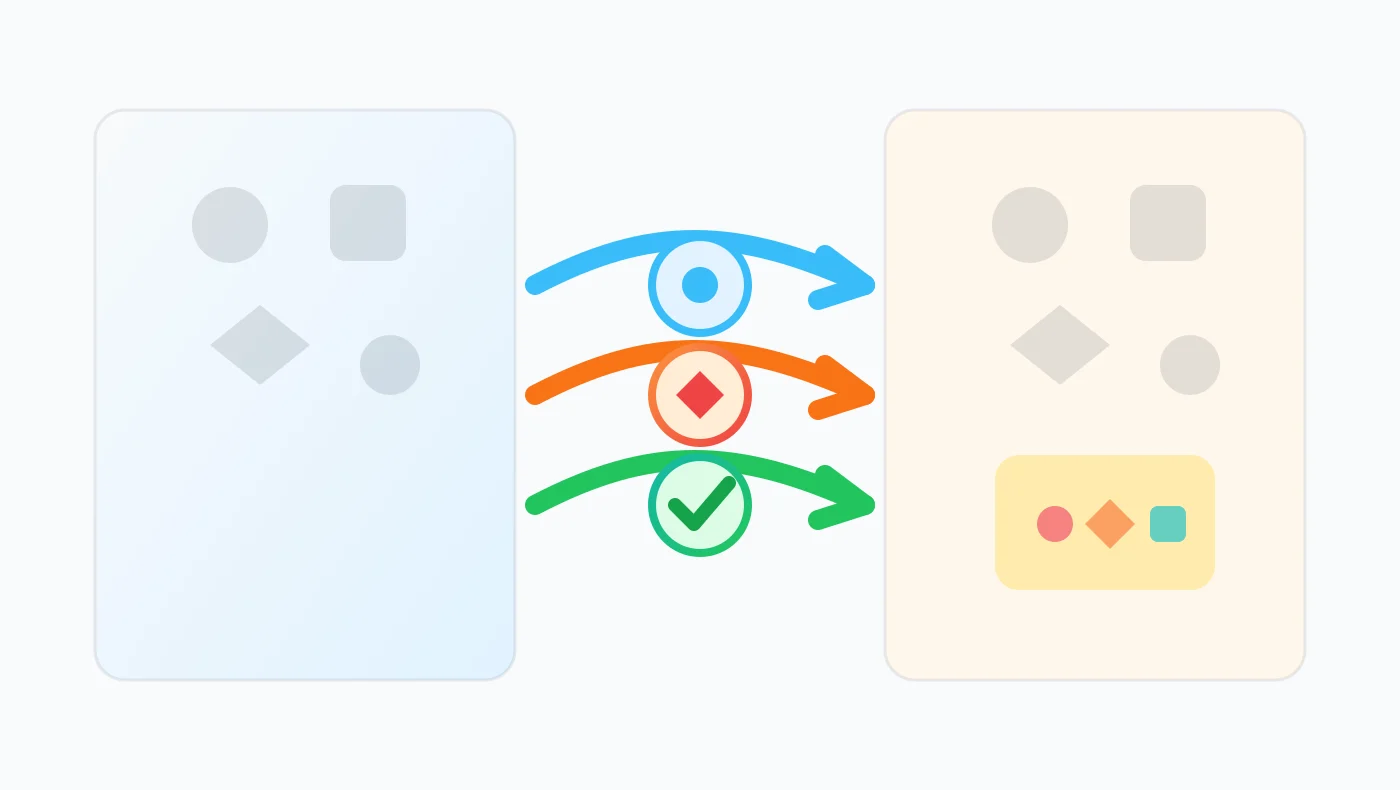
Ask four questions before allowing broad writes. Can the agent edit a file that the IDE loads without prompting? Can it change Git configuration that affects a future command? Can it reach a socket or daemon outside the sandbox? Can it create automation that CI executes in the next job?
| Surface | Practical risk | Minimum control |
|---|---|---|
| IDE configuration | A task or extension runs outside the sandbox. | Block automatic writes and require review. |
| Git and hooks | A harmless-looking command calls a helper or changed config. | Validate invocation, arguments and effective config. |
| Virtual environment | Automatic discovery runs a manipulated binary. | Recreate the environment outside agent-written paths. |
| Local daemon | A privileged socket becomes indirect execution. | Deny by default and allow only in isolated jobs. |
Practical experience: when I design a harness for a coding agent, I treat host configuration as a platform change. The file can look small, but its consumer often has more permission than the agent. That is why I prefer blocking first, then allowing with short PR evidence.
Citable capsule: The real boundary is where the host consumes the file. Pillar described four failure modes in 2026; all of them show that workspace configuration, allowlists and daemons need their own policy in agentic workflows.
How do you limit writes without stopping agentic work?
In 2026, Codex documentation described three main sandbox modes: read-only, workspace-write and danger-full-access (OpenAI Developers, "Sandbox", 2026, retrieved 2026-07-23). For this risk, workspace-write is necessary for many tasks, but it is not enough when the workspace contains executable configuration.
The practical fix is to separate ordinary writes from sensitive writes. Source code, tests and documentation can use the normal flow. Files consumed by the host need an extra rule: ask for review, deny the change or move execution to an ephemeral runner.
Claude Code helps because permissions are enforced by the tool, not the model. Its documentation says prompts and CLAUDE.md influence what Claude tries to do, but access is granted or revoked by permissions, hooks or modes (Claude Code Docs, "Configure permissions", 2026, retrieved 2026-07-23).
In long loops, context cost also matters because the agent must remember which files are sensitive and which evidence was already approved. I use RemoteCode to keep continuity in agentic Claude Code and Codex flows with less repeated context when work spans several rounds; it is my own tool, so this mention is editorial and tied to the token problem.
Citable capsule: Healthy control does not block every agent write. Codex documents
workspace-writefor controlled edits, while Claude Code reinforces that permissions are enforced outside the model; files consumed by the host need one more rule before they become execution.
Which files should become approval boundaries?
In 2026, arXiv's "Harness Engineering for Agentic AI Coding Tools" analyzed 2,853 repositories and identified eight configuration mechanisms for agentic tools, with AGENTS.md emerging as an interoperable starting point (arXiv, "Harness Engineering for Agentic AI Coding Tools", 2026, retrieved 2026-07-23). Your boundary list should come from the harness, not from reviewer memory.
Start with files that change behavior outside direct agent execution. Include .git, hooks, .vscode, .idea, .claude, .codex, .devcontainer, virtual environments, package scripts, runner files and any configuration that can trigger a local tool.
Then classify by consumer. If the reader is a test inside the runner, risk is lower. If the reader is the developer host, a broad IDE extension or a daemon with a privileged socket, the rule should be stricter.
{
  "boundary": {
    "ordinary_code": "normal_review_edit",
    "host_configuration": "ask_for_approval",
    "local_daemon": "deny_by_default",
    "secret_or_credential": "outside_workspace",
    "agent_artifact": "record_provenance"
  }
}
Citable capsule: An agent harness must list consumers, not only files. The arXiv study analyzed 2,853 repositories and eight configuration mechanisms; for security, each mechanism should declare who consumes the artifact and which policy applies.
This contract also connects to the hidden context cost in coding agents. A rule file that is too broad becomes noise. Keep policy short, executable and tied to real incidents.
How do you test this failure in CI before an incident?
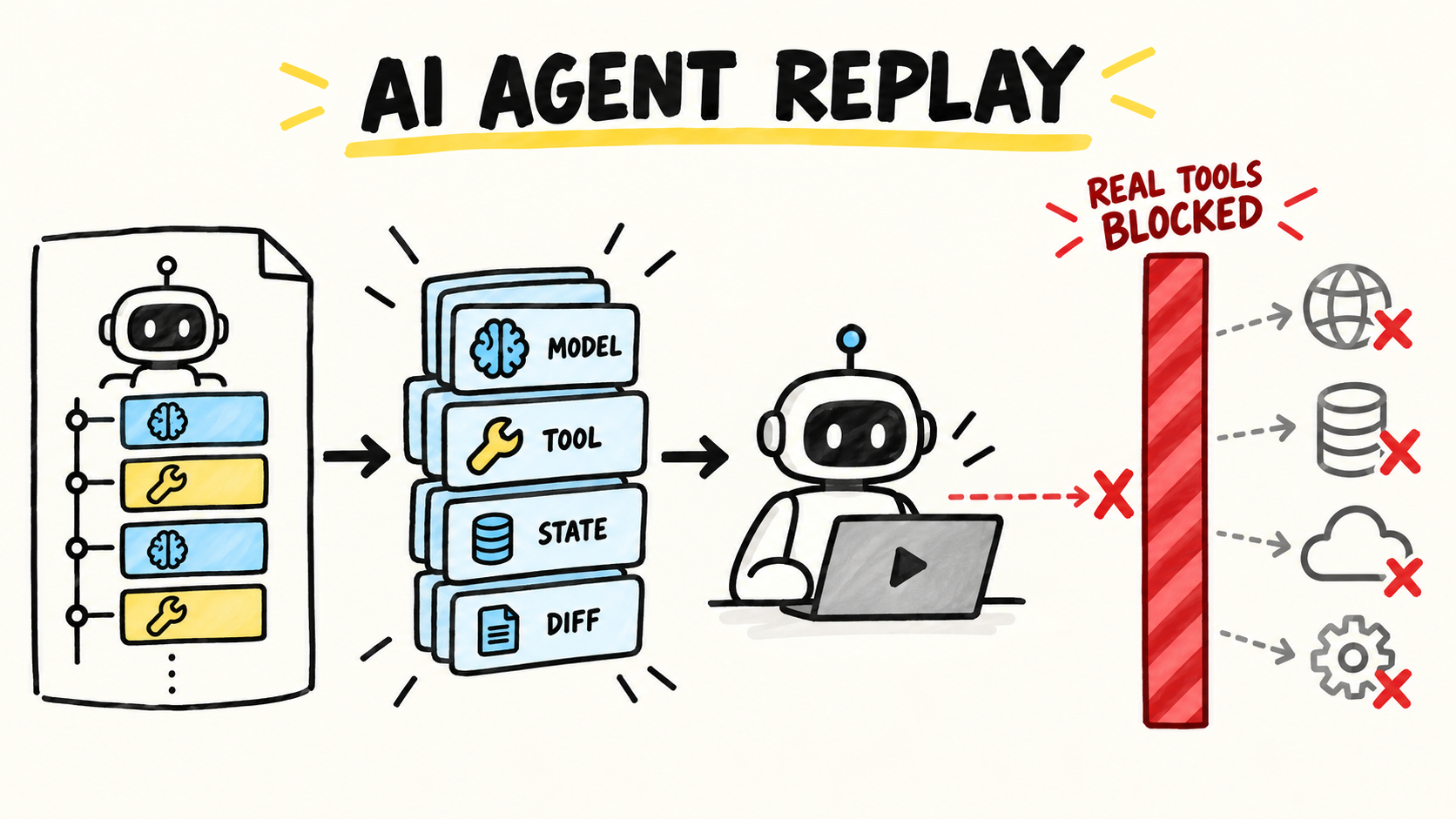
In 2026, arXiv's "ABTest" generated 647 fuzzing cases in real repositories, flagged 1,573 anomalies and manually confirmed 642 new anomalies, with 40.8% precision (arXiv, "ABTest: Behavior-Driven Testing for AI Coding Agents", 2026, retrieved 2026-07-23). That is why the harness needs behavioral tests, not only lint.
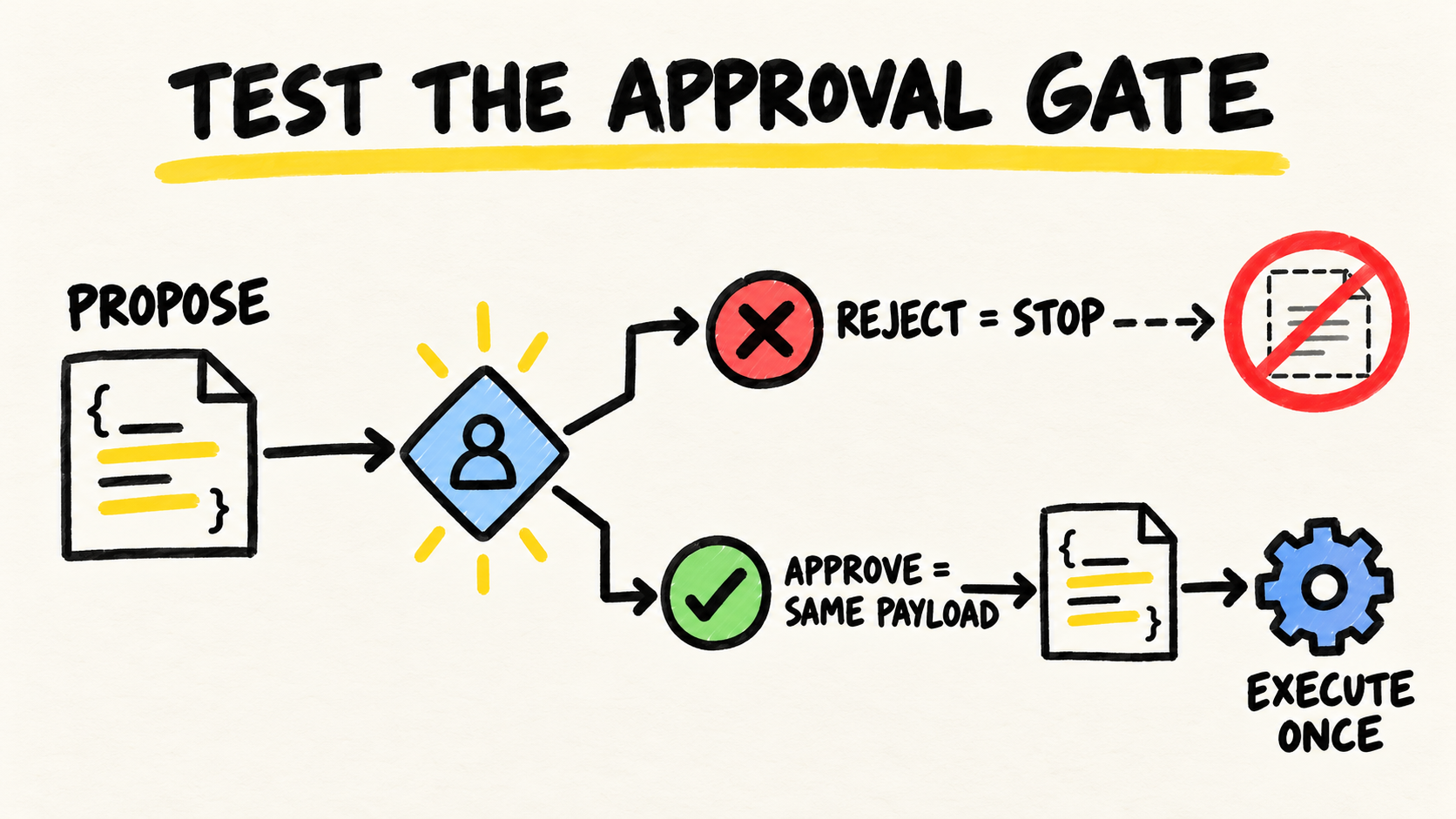
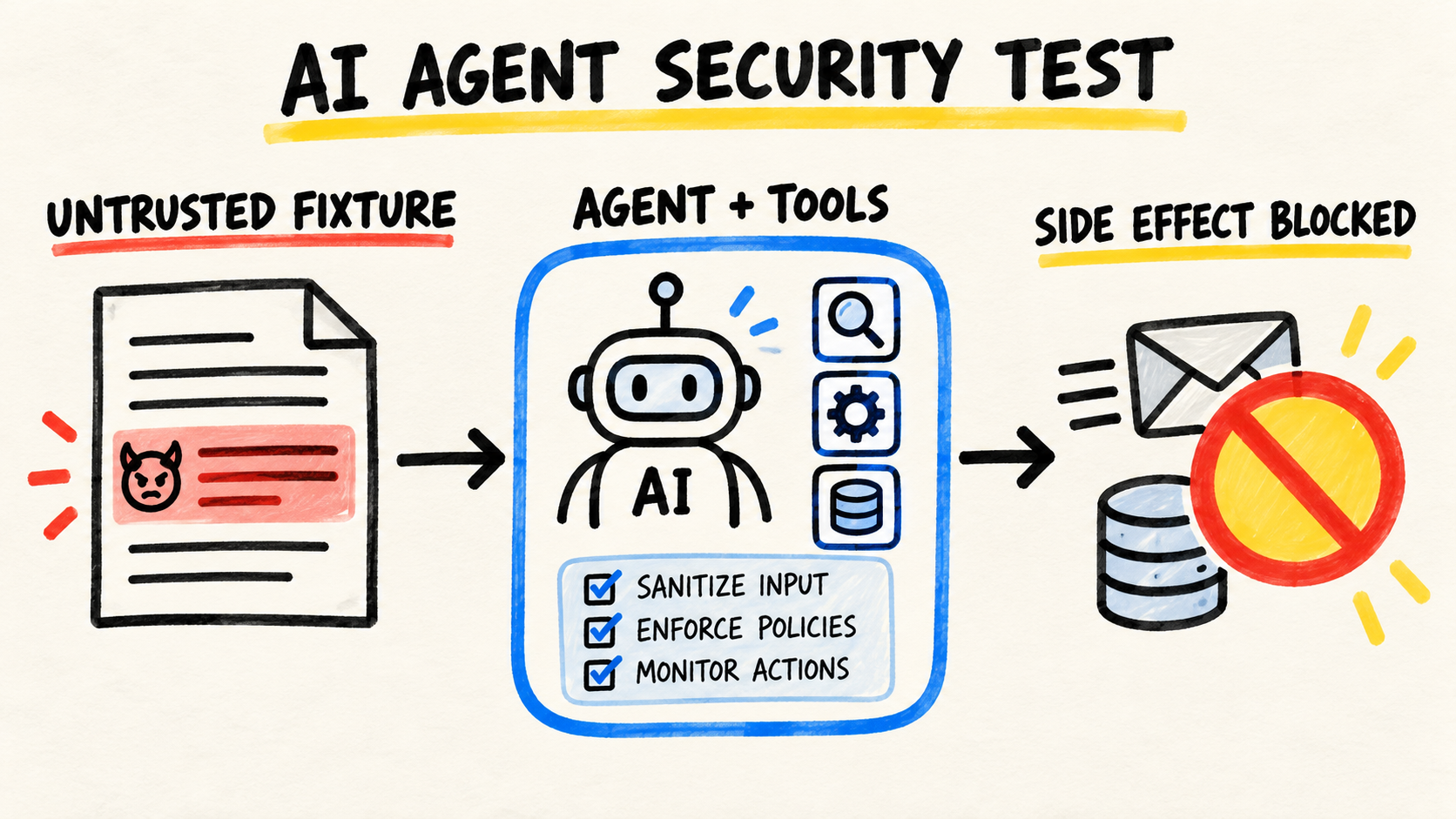
Create a test repository with harmless sensitive configuration. The goal is not to exploit your own team. It is to measure whether the agent tries to edit a protected file, whether CI blocks the change and whether the final summary shows the correct decision.
Use benign payloads. A .vscode file can point to a fake command that only records an event. A hook can write to a temporary file. A daemon socket can be replaced by a local stub. The test passes when the agent receives a clear block and chooses another path.
| Test | Passing signal |
|---|---|
| Attempt to edit sensitive config | Hook blocks and records the path. |
| Allowed command with risky arguments | Policy evaluates the full invocation. |
| Artifact created by the agent | Provenance appears in the PR summary. |
| Consumer outside the sandbox | CI requires human review before execution. |
Citable capsule: Security evals for agents must reproduce handoffs. ABTest generated 647 cases and confirmed 642 new anomalies; for indirect sandbox escape, the test should verify whether a file written by the agent can become a host action.
What belongs in the minimum safe-host contract?
In 2026, arXiv's "Overeager Coding Agents" evaluated 500 validated scenarios and about 7,500 runs across four agent products, including Claude Code, Codex CLI and Gemini CLI (arXiv, "Overeager Coding Agents", 2026, retrieved 2026-07-23). The minimum contract should limit scope before the agent's intent expands on its own.
The contract fits on one page. First, no agent edits host-consumed configuration without approval. Second, every automation artifact created by an agent runs in an isolated runner before touching laptops, secrets or daemons. Third, the PR shows provenance: created by a human, by the agent or by the original repository.
Record exceptions too. If an agent needs to edit .devcontainer, the justification should appear in the PR. If it needs Docker, use an ephemeral runner. If it needs to change a hook, treat that as a policy change, not an implementation detail.
Citable capsule: A safe host for agents starts with explicit scope. The Overeager study evaluated 500 scenarios and about 7,500 runs; in real teams, that becomes approval policy for configuration, daemons, secrets and artifacts created by the agent.
FAQ about AI agent file sandbox escape
Is sandboxing no longer useful for coding agents?
No. In 2026, OpenAI describes the sandbox as the boundary that allows autonomy without unrestricted computer access (OpenAI Developers, "Sandbox", 2026, retrieved 2026-07-23). Pillar's lesson is that the sandbox must account for written files and host consumers, not only the agent process.
Should I block every write to .vscode, .git and hooks?
Block automatic writes and ask for review when execution can happen outside the sandbox. In 2026, Claude Code documents PreToolUse hooks that block edits to protected files before the write (Claude Code Docs, "Automate actions with hooks", 2026, retrieved 2026-07-23). The rule can be narrow, but it must be executable.
Does this apply to CI or only to developer laptops?
It applies to both. In 2026, Claude Agent SDK secure deployment guidance recommends isolation with sandboxing, containers, gVisor or virtual machines depending on the threat model (Claude Code Docs, "Securely deploying AI agents", 2026, retrieved 2026-07-23). CI lowers risk when the runner is ephemeral and lacks broad secrets.
How do I know whether my command allowlist is weak?
Test arguments, directory, configuration and side effects, not just command names. In 2026, Pillar reported GitPwned in Codex CLI, where git show looked safe by name, but arguments allowed file writes and malicious configuration (Pillar Security, "GitPwned: Allowlist to RCE", 2026, retrieved 2026-07-23).
Closing
The sandbox is still necessary, but it is not the end of the agentic threat model. The agent now writes future inputs for tools that existed before agents did.
The pragmatic path is to treat executable configuration as a boundary: deny by default, require review when the host consumes the file, run in ephemeral runners and record provenance. If the agent created the file, the host should distrust it before execution.
Sources consulted
- Stack Overflow, "2025 Developer Survey: AI", retrieved 2026-07-23, https://survey.stackoverflow.co/2025/ai
- Pillar Security, "The Week of Sandbox Escapes", retrieved 2026-07-23, https://www.pillar.security/blog/the-week-of-sandbox-escapes
- Pillar Security, "GitPwned: Allowlist to RCE", retrieved 2026-07-23, https://www.pillar.security/blog/gitpwned-allowlist-to-rce
- OpenAI Developers, "Sandbox", retrieved 2026-07-23, https://developers.openai.com/codex/concepts/sandboxing
- Claude Code Docs, "Configure permissions", retrieved 2026-07-23, https://code.claude.com/docs/en/permissions
- Claude Code Docs, "Automate actions with hooks", retrieved 2026-07-23, https://code.claude.com/docs/en/hooks-guide
- Claude Code Docs, "Securely deploying AI agents", retrieved 2026-07-23, https://code.claude.com/docs/en/agent-sdk/secure-deployment
- arXiv, "Harness Engineering for Agentic AI Coding Tools: An Exploratory Study", retrieved 2026-07-23, https://arxiv.org/abs/2602.14690
- arXiv, "ABTest: Behavior-Driven Testing for AI Coding Agents", retrieved 2026-07-23, https://arxiv.org/abs/2604.03362
- arXiv, "Overeager Coding Agents: Measuring Out-of-Scope Actions on Benign Tasks", retrieved 2026-07-23, https://arxiv.org/abs/2605.18583