

If a coding agent can assemble a patch in a few minutes, the session still needs to answer a harder question: what can you explain after the agent is done? When you are learning software engineering, that answer matters more than the speed of the first result.
In 2026, the Stack Overflow pulse on domain expertise and AI-assisted learning found growing use of AI for learning, while also recording lack of trust in the result as the most common barrier. That points to a practical method: use the agent to shorten the path from a question to feedback, not to skip the step where you form a hypothesis.
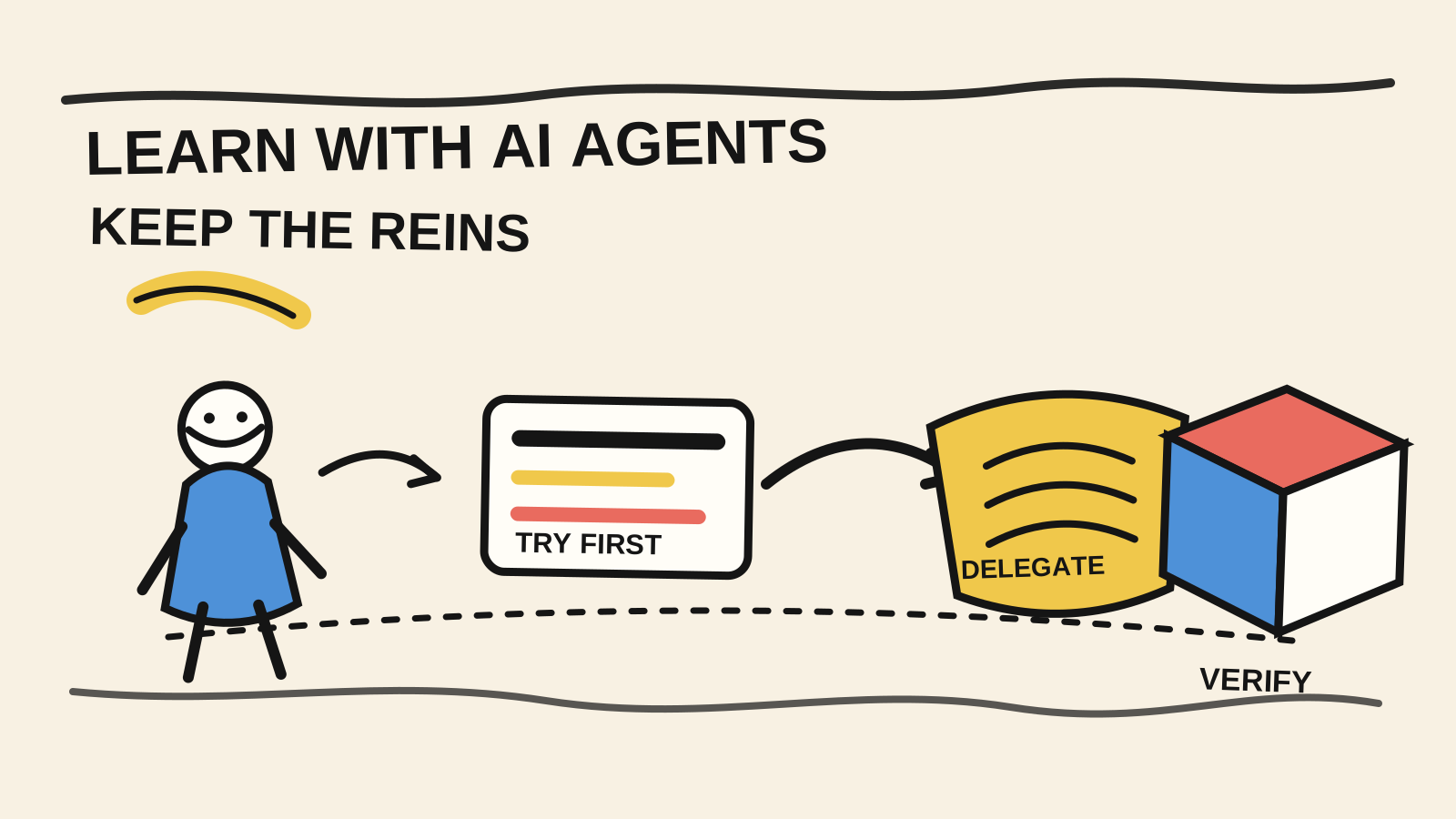
This guide turns that method into five moves. You try first, delegate a limited part, explain what you received, verify it with a real check, and record what you still do not understand. The tool can be Claude Code, Codex, Copilot, or another agent. The loop is what lasts.
If you want to know which skills matter at work, start with the guide to software engineering skills for coding agents. This article answers a narrower question: how do you learn without handing the steering wheel to the agent?
Short answer
- Form a solution or a question before opening the agent.
- Delegate boilerplate, comparison, and explanation, but keep architecture decisions.
- Read and explain the result without asking the agent to do the thinking for you.
- Test a hypothesis that can fail and record the risk that remains open.
Does using an agent to study mean you should stop coding?
No. In 2025, the Stack Overflow Developer Survey: AI recorded more developers distrusting tool accuracy, at 46%, than trusting it, at 33%. That result does not prove agents are bad for learning. It explains why generation needs to stay separate from comprehension and verification.
Treat the agent as a tool with different roles. It can be a teacher when it explains a concept, a partner when it compares options, a generator when it writes repetitive code, and a reviewer when it looks for counterexamples. The session gets risky when those roles blur and you treat generated output as proof that you understand it.
The practical boundary is simple: delegate an artifact you can inspect. Do not delegate a decision you cannot yet evaluate. If you cannot say what would make the answer wrong, you are still learning the subject. Ask for a smaller example, an explanation, or a primary source.
What should you do before asking AI to write code?
Start with your own model of the problem. A study of 50 educators and 90 students, Design Implications for Student and Educator Needs in AI-Supported Programming Learning Tools, found a useful difference: educators preferred indirect help that preserved reasoning, while students were more likely to prefer direct, actionable help. For learning, the rule is clear: produce the next decision before asking for the answer.
Before opening the agent, write four lines:
- Problem: what behavior needs to change?
- Hypothesis: what solution would you try, and why?
- Question: which part cannot you justify yet?
- Proof: what test, example, or observation could show the hypothesis is wrong?
The draft does not need to be correct. It separates a real gap from the urge to see finished code. If your hypothesis is wrong, the agent can correct it without erasing the path that led to the question.
Ask for a critique of the draft first. Which edge cases are missing? Which assumptions have not been shown? Which concept should you review? Only then ask for a short example or implementation. The order matters because you can compare the suggestion with an idea that started as your own.
How should you divide a session with a coding agent?
Use a loop with explicit boundaries: you define the intent, the agent helps you explore, you limit the patch, and an independent check decides whether the result works. The study Evolution of Programmers' Trust in Generative AI Programming Assistants points in the same direction by highlighting comprehension, debugging, and testing as ways to calibrate trust in programming assistants.
A study session can follow these steps:
- Try: implement a small version or write the algorithm in words.
- Ask: have the agent explain an alternative and its trade-offs.
- Delegate: hand over only the part you can review, with scope and limits.
- Rewrite: close the conversation and explain the code, data, and likely failures.
- Verify: run tests, invent a difficult input, and compare it with your first hypothesis.
Do not turn every step into a ceremony. For a small function, the attempt may be a two-minute sketch. For a queue, API, or authentication flow, it should include invariants, external effects, and failure modes. The ritual should grow with the risk of the decision.
When the answer does not make sense, do not ask only for a corrected version. Ask which assumption failed and try to change the code yourself. Manual correction is part of learning, even when the agent could produce another version faster.
Which parts are worth doing without the agent?
Do the parts that form the mental model you need to evaluate the rest: define the contract, draw the data flow, choose invariants, predict failures, and interpret the test. You do not need to write every import or repeat boilerplate to prove you learned. You need to reconstruct the decision when the implementation changes.
It is also worth practicing without assistance in short blocks. Write a function, read a stack trace, model a table, or review a diff without opening the chat. Then ask the agent to compare your answer with other options. This gap reduces the risk of confusing recognition of an explanation with command of the problem.
The 2026 Stack Overflow pulse found that 64% of surveyed developers use AI to learn and that only 1% use AI alone. Most combine AI with documentation, search, forums, or communities (Stack Overflow, "Domain expertise still wanted: the latest trends in AI-assisted knowledge for developers"). Use that combination as a study rule: the agent's answer is a clue; documentation and execution are ways to check the clue.
Do not impose total abstinence if it makes the learning process artificial. The goal is to preserve the decisions you need to make at work. If the agent writes a repetitive adapter, but you can explain its contract, review error handling, and test the integration, delegation may be sensible.
How can you study a repository without accepting a ready-made map?
Learn the repository in layers. First, try to draw the path from input to output using the files you have found. Then ask the agent to point out what you missed, requiring paths, symbols, and sources. Finally, confirm the explanation by reading the code and making a small change.
The codebase RAG guide for coding agents shows how retrieval helps an agent ask better questions. For learning, reverse the direction: the answer should lead you to files and decisions you can check, not replace reading the codebase.
Ask for three separate maps:
- the normal request flow;
- the error and retry flow;
- data, permission, and external-effect boundaries.
Compare the maps with what you can prove in the code. Label each statement as confirmed, likely, or unknown. That small habit stops a well-written narrative from becoming a false sense of mastery.
If the repository has instructions for agents, read them as part of the system, not as authority over the truth. The hidden context cost in coding agents helps explain what deserves a place in the prompt. For learning, the criterion is similar: keep context that changes your decision and discard text that only sounds complete.
What signs show that you are becoming dependent on the agent?
You are becoming dependent when you stop forming hypotheses, cannot explain a file without asking for another answer, or accept tests you cannot interpret. A second sign is being unable to continue when the service is down, the context is lost, or the suggestion does not compile.
These signs do not mean you must abandon the tool. They show which step needs to move back to your side of the flow. If you cannot explain the algorithm, write a manual example. If you do not understand the error, reproduce it with a minimal input. If you cannot evaluate the architecture, compare two options with the same criteria before asking for a recommendation.
Run an autonomy check at the end of the session:
- Close the agent and describe the change in five sentences.
- List the files touched and why each one changed.
- Name the test that would fail if the main rule broke.
- Point to one thing that has not been measured.
If you get stuck, do not turn that moment into shame or another automatic call. Record the unanswered question and return to the fundamentals. Dependence falls when the tool becomes feedback, not when you try to prove that you can work without it all the time.
How can you turn this method into a four-week plan?
Organize study by risk, not by the amount of code produced. Each week should end with evidence another person can read or run. That keeps progress from being measured by generated commits and focuses practice on understanding you can show.
Week 1: reading. Choose a small repository. Draw the normal and error flows, read the official documentation, and ask the agent only for orientation. Confirm three statements in the code.
Week 2: implementation. Choose a short change. Write the contract and a test before delegating boilerplate. Compare your plan with the diff and correct one part yourself.
Week 3: failures. Create invalid inputs, timeouts, or empty responses. Ask the agent for counterexamples, but reproduce them yourself. Record which assumption was wrong and which protection you added.
Week 4: explanation. Open the project in a clean window. Reconstruct the path without the conversation history, write a short architecture decision, and ask another person to question the residual risk.
The AI software engineer portfolio guide shows how to turn problems, decisions, and checks into public evidence. Do not copy its format as a requirement. Use it to find out whether your study left an artifact that survives the session's memory.
How do you know whether this study prepares you for work?
Study is on the right track when you can change roles. In one task you may ask for implementation. In another, you may review a teammate's change. In a third, you may investigate an incident without a ready-made answer. Competence is not using the agent the same way every time. It is knowing which part needs human reasoning, which part accepts automation, and how to verify the boundary.
Connect each exercise to a real risk: inconsistent data, incorrect authorization, duplicate retries, an incompatible schema, or weak observability. Then use tests and documentation to separate what was proved from what still depends on judgment.
As your project grows, PR evals that keep code agents honest in CI show how to make verification repeatable. A career does not require memorizing a tool. It requires owning the consequence of a change and showing how you reached the decision.
Frequently asked questions
Do I need to write all the code myself to learn?
No. Write the decisions, contracts, and small pieces that form your mental model. Delegate repetitive code when you can review the result and test its behavior. The study Evolution of Programmers' Trust in Generative AI Programming Assistants recommends comprehension, debugging, and testing to calibrate trust, not a rule of total authorship.
Can I ask the agent to explain code it generated?
Yes, but treat the explanation as a hypothesis. Design Implications for Student and Educator Needs in AI-Supported Programming Learning Tools describes the tension between direct help and scaffolding that preserves reasoning. Before accepting the answer, compare it with the code, documentation, and a test that can reveal a false assumption.
How can I study AI engineering without getting stuck with one tool?
Learn contracts that survive a vendor switch: data flow, embeddings, queues, authentication, retries, tests, observability, and permission boundaries. Use the current tool to practice those concepts, but record decisions in terms of behavior and risk. The model can change without erasing what you learned about the system.
What if I learn more slowly with this method?
You may spend more time on the first attempt, but the goal is not to win the shortest session. It is to explain, debug, and repeat the solution later. If the ritual becomes heavy, reduce the task's scope. Do not remove the hypothesis and the proof. They distinguish understanding from familiarity with plausible output.
Conclusion
Learning programming with agents does not require choosing between total autonomy and total delegation. A useful career method alternates the roles: you formulate, the agent expands, you limit, the test challenges, and the explanation shows what stayed with you.
Start with a small task. Try before asking, delegate only what you can review, and end the session with a check that can fail. In long Claude Code and Codex flows, I use RemoteCode as the author's tool for continuing work between sessions. It helps preserve continuity, but it does not replace study, reading the diff, or responsibility for a decision.
Sources consulted
- Stack Overflow, "AI | 2025 Stack Overflow Developer Survey", retrieved 2026-08-09
- Stack Overflow, "Domain expertise still wanted: the latest trends in AI-assisted knowledge for developers", retrieved 2026-08-09
- Boxuan Ma et al., "Design Implications for Student and Educator Needs in AI-Supported Programming Learning Tools", retrieved 2026-08-09
- Koli Calling, "Evolution of Programmers' Trust in Generative AI Programming Assistants", retrieved 2026-08-09