

A demo can prove that a project responds. It does not prove, by itself, that the person understood the problem, chose a reasonable boundary, or checked what happens when something fails. To evaluate a software engineer portfolio, trace the path between the project's claim and the evidence another person can inspect.
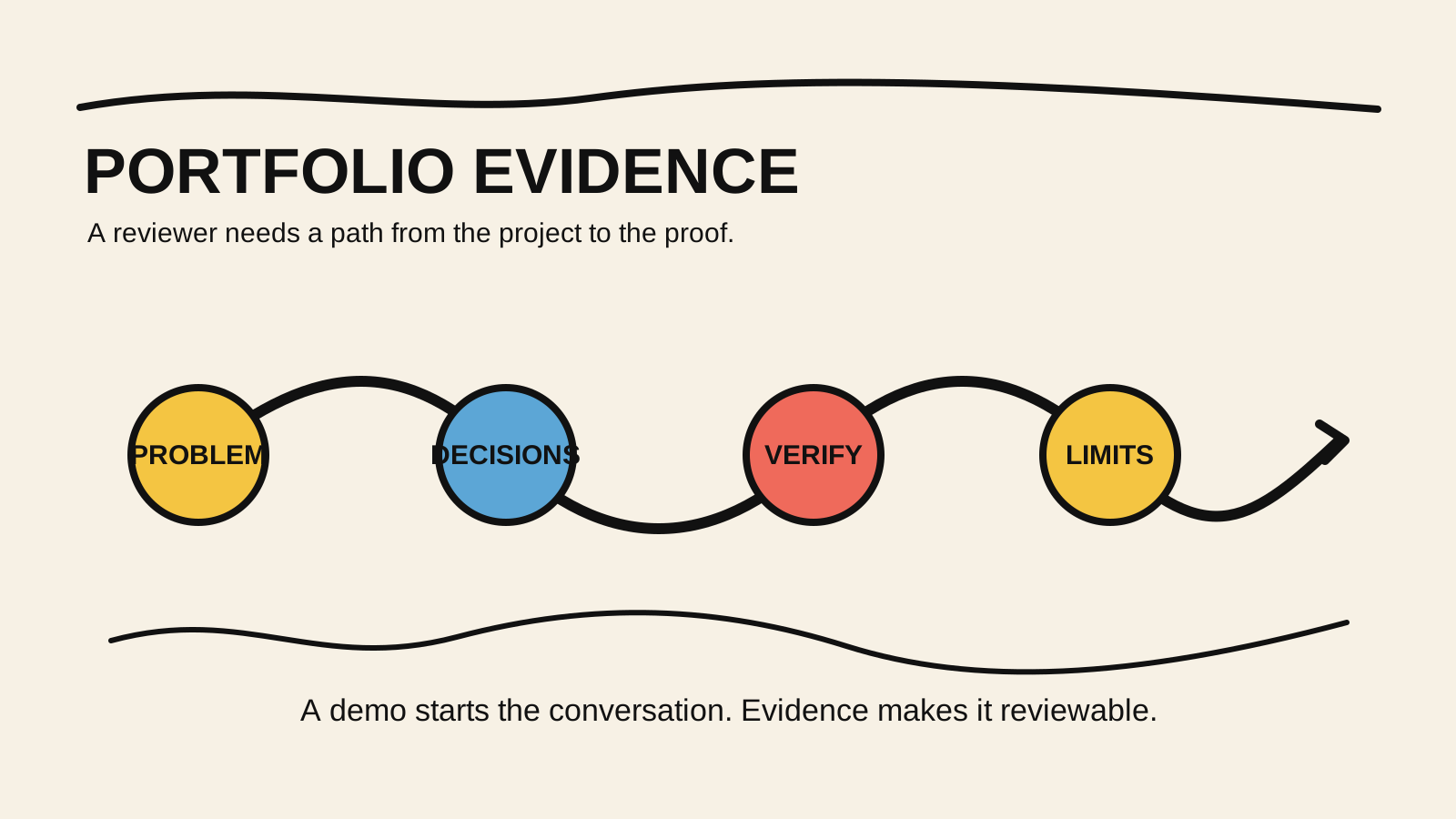
The most useful route has four passes: problem, decisions, verification, and limits. Then ask about authorship and next steps. This turns a repository into a technical conversation. It does not create a universal hiring score or replace a structured interview.
The guide to what an AI software engineer portfolio should prove looks at the same subject from the candidate's side. This page asks a different question: what can a reviewer confirm without guessing?
Key Takeaways
- Start with the problem the project claims to solve, not the number of technologies.
- Look for visible decisions and a contribution the person can explain.
- Check for a reproducible path through behavior, failures, and data.
- Read limits as evidence of judgment, not as automatic defects.
- Use the result to choose better questions, not to infer a whole career.
1. Does the project make its problem clear?
Read the README before opening the code. In a few lines, you should learn who has the problem, what behavior changes, and what is outside the scope. If the first screen is a list of frameworks or a context-free video, the review starts with a gap.
A good portfolio problem does not need to be a business problem or have real users. It does need to be specific enough for you to ask what success means. "I built a chatbot" describes technology. "I organized a team's documents and refuse an answer when I cannot find a source" points to input, behavior, and a limit.
Do not turn production scale into a requirement. A personal project may use small data, run only locally, or have a simple interface. The question is whether the author explains the scope and its consequences. The guide to software engineering skills for coding agents helps separate the technology used from the capability a project is meant to demonstrate.
Look for the sentence that says what the project will not solve. Out of scope is not paperwork. It shows whether the author can reduce a large idea to a problem that can be built and checked.
2. Where are the engineering decisions?
Once you understand the problem, look for choices that could have gone another way. Why is there a queue? Why does state live in a database? Why is a permission denied? Why does the application return a partial answer instead of retrying?
A tool list does not answer these questions. Look for a short decision record, a diagram, an explanatory commit, or a README section that connects a choice to a risk. You do not need a large architecture. You need to find out whether the person can explain the cost of a choice.
A useful review can follow this table:
| Reviewer question | Evidence to look for | Follow-up question |
|---|---|---|
| What was the main risk? | problem, constraints, and out-of-scope work | What happens if that assumption fails? |
| Which decision protects that risk? | contract, boundary, diagram, or test | What alternative did you reject? |
| Who controls the effects? | permissions, data, writes, and integrations | What still depends on a person? |
| How is the change checked? | test, fixture, eval, log, or command | What case could make the proof fail? |
| What remains unknown? | limits, future work, and residual risk | How would you reduce that uncertainty? |
Do not give a decision more weight because it uses a familiar tool. A small project with a well-explained boundary can show more judgment than a component-heavy architecture the author cannot defend.
3. Is the proof executable or only descriptive?
Look for a short path through the project. It may be an installation command, fixture, test, screenshot, or input and output example. The format depends on the project. The requirement is that the main claim has a way to be challenged.
For model-based projects, do not confuse a polished answer with an evaluation. OpenAI's evals documentation models an evaluation with input data, testing criteria, and results. You can ask the same question of a portfolio without using OpenAI's API: what input was chosen, what behavior was expected, and where is the result recorded?
Good proof also shows failure. Look for empty inputs, missing permissions, timeouts, duplicates, invalid responses, or a case the project admits it does not solve. A personal project does not need a complete test suite. It should not depend on "open the link and trust it" as the only path.
For a project that uses coding agents, PR evals in CI show how review evidence can become a repeatable step. The portfolio version can be smaller, as long as the input, criterion, and result are visible.
If the repository needs an unavailable account, paid service, or setup nobody can repeat, record that as a limit of the evidence. Do not automatically conclude that the project does not work. Reduce only what you claim to have verified.
4. How should you evaluate an AI-assisted project?
For an AI-assisted project, the question is not whether the person used a model. Ask where they retained responsibility: problem definition, context selection, diff review, testing, integration, and risk decisions.
The research paper When AI Can Build It, What Should We Assess? proposes separating product, process and origin, verification, explanation, reflection, and individual assurance evidence in an AI-permissive engineering course. It is not a universal hiring rubric. It is a useful lens for avoiding the mistake of treating the final product as the only proof.
Ask the person to choose one small change and explain the path. They should be able to say:
- what request they received and what part they bounded;
- what context or source they gave the agent;
- which suggestion they rejected or changed;
- which test or inspection they ran afterward;
- which risk remains unproven.
You do not need to request the full agent transcript. A full history can hide the important decision in too much text. A faithful summary, diff, test, and short explanation are more useful. If the project uses Claude Code, Codex, or another tool across long sessions, the author may use RemoteCode as a work tool. That describes the author's method; it is not evidence that the project is good.
Avoid the unfair test of asking the person to recreate the whole repository live. If a question remains, choose one part of the project and ask for a limited change or failure analysis. The goal is to observe understanding, not to request free work.
5. What do the limits tell you?
Read the limitations section before forming an opinion. An author who writes "I did not measure real load" is making a more trustworthy claim than someone who calls a project production ready without explaining observability, data, or recovery.
Separate three things that are often mixed together:
- Not implemented: the project does not do something yet.
- Not verified: the project does something, but the available evidence does not cover it.
- Outside the goal: the project never intended to solve that problem.
This separation leads to better questions. For a personal API, real traffic may not be necessary. For an application that promises to prevent data loss, you need to know which scenario was tested and which is still only an intention. The review should respect the problem the project chose.
Also check ownership of materials. Tutorial code, forks, group work, private data, and AI assistance may all appear in a portfolio. Using an existing base is not the problem. The problem is allowing a reviewer to attribute work to the author that the repository does not demonstrate. The README should distinguish contribution, dependencies, and adapted parts.
6. How do you turn the reading into a fair conversation?
Do not add points as if a portfolio were a standardized test. Record four observations: what is clear, what the evidence supports, what remains open, and which question could reduce the uncertainty. This avoids rewarding design, repository size, or commit count without understanding the work.
A conversation can start with:
- "Which part of this project would you change if the input doubled?"
- "Show me a case where the verification fails or is not enough."
- "Which decision was hardest to review after the first implementation?"
- "What did you delegate, and what did you rewrite?"
- "Which claim about the project would you not make yet?"
Make the questions proportional to the project. An entry-level portfolio does not need the operations of a commercial service. Someone who claims to have built a resilient system should be able to explain recovery, observability, and the limits of the proof.
If the review is part of a selection process, agree in advance on what will be observed and how much time the person has. Do not turn the checklist into a hidden assignment. If it is a peer review, return questions and evidence, not just an impression about the person.
Final checklist for a portfolio review
Before you finish, check whether you can complete each row without inventing an answer:
| Area | Can you point to... |
|---|---|
| Problem | the need, user or operator, and project boundary? |
| Contribution | what the person built, adapted, delegated, or reused? |
| Decisions | a technical choice tied to a risk or requirement? |
| Verification | a command, test, eval, or example that can fail? |
| Operations | how the project handles errors, sensitive data, access, or recovery? |
| Limits | what is not implemented or proven yet? |
| Conversation | one concrete question that reduces uncertainty? |
If several cells are empty, do not fill the gap with assumptions. Say what evidence was missing and ask for a short explanation. The value of the checklist is making uncertainty visible.
Conclusion
Evaluating a software engineer portfolio means tracing the distance between what the project claims and what it lets you verify. Start with the problem. Look for decisions tied to risks. Run or read a proof. Then ask about authorship, limits, and next steps.
This method does not turn a repository into a verdict on a career. It improves the conversation and avoids two common mistakes: confusing a polished demo with engineering, and dismissing a small project because it does not look like a complete product. The best review ends with a precise statement about what was demonstrated and an honest question about what was not.
How this article was produced
Samuel Fajreldines is responsible for this article. The research compared the site's existing cluster, current results in Portuguese, English, and Spanish, recent public discussions, GitHub and OpenAI documentation, and research on engineering assessment in AI-permissive settings. The checklist is editorial synthesis. It is not the result of a hiring study, candidate benchmark, real interview, or employer evaluation.
AI assistance supported source discovery, comparison, first drafting, localization, SVG illustration creation, and consistency review. It did not evaluate candidates, test real people's portfolios, or provide professional experience the author has not demonstrated.
Sources consulted
- GitHub, "Managing your profile README", accessed 2026-11-01.
- OpenAI, "Working with evals", accessed 2026-11-01.
- Ali Shakiba et al., "When AI Can Build It, What Should We Assess?", accessed 2026-11-01.