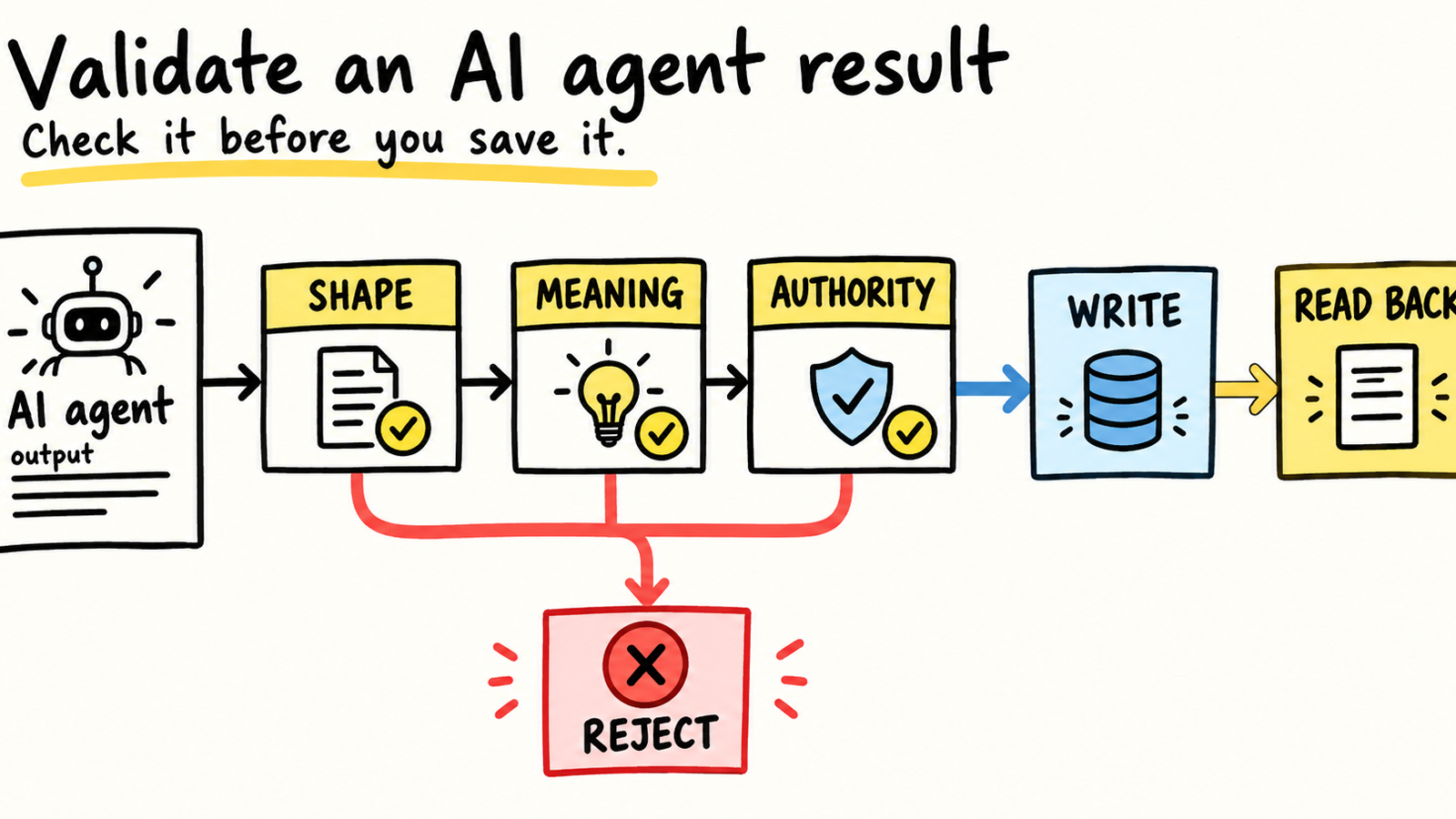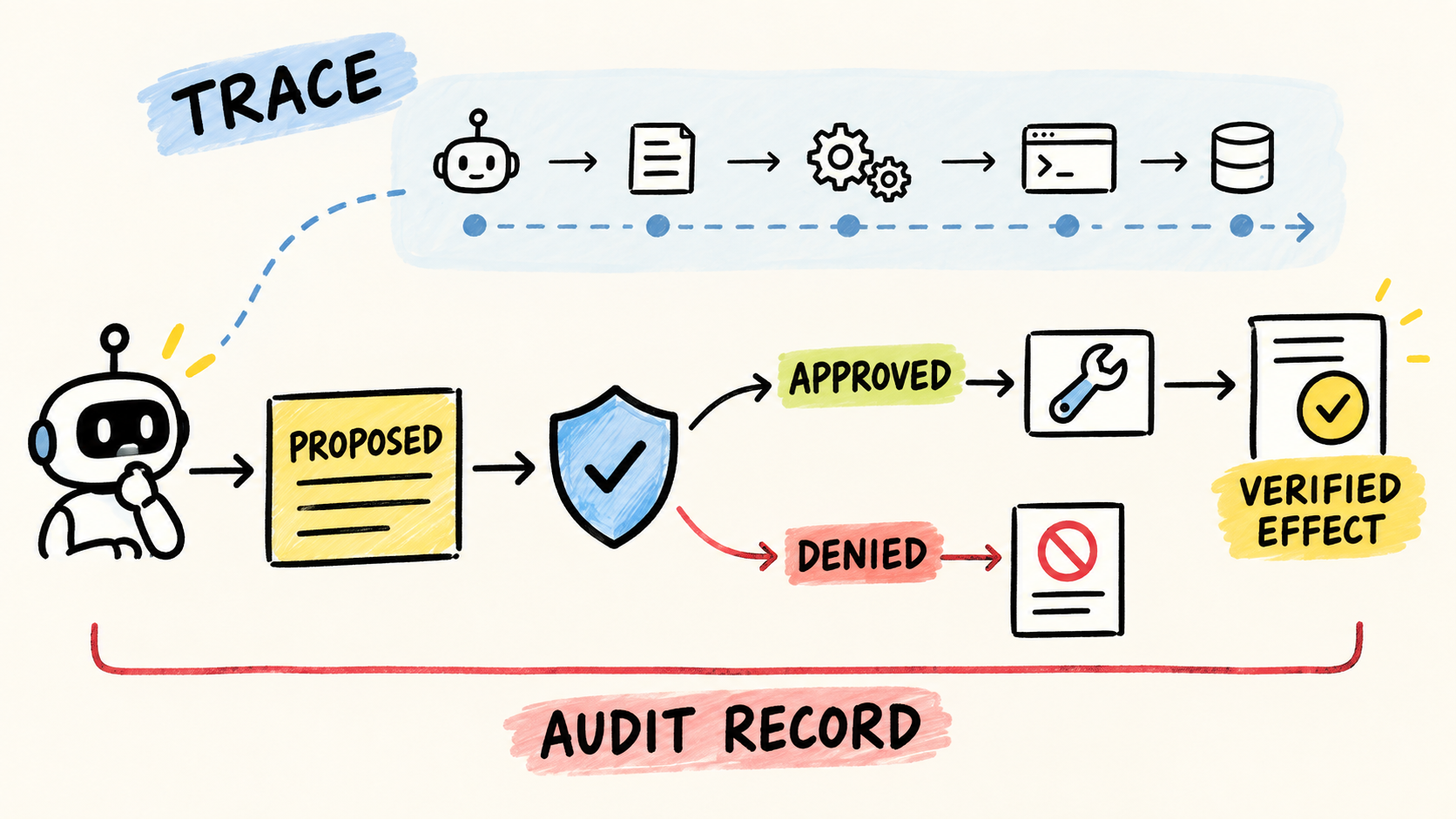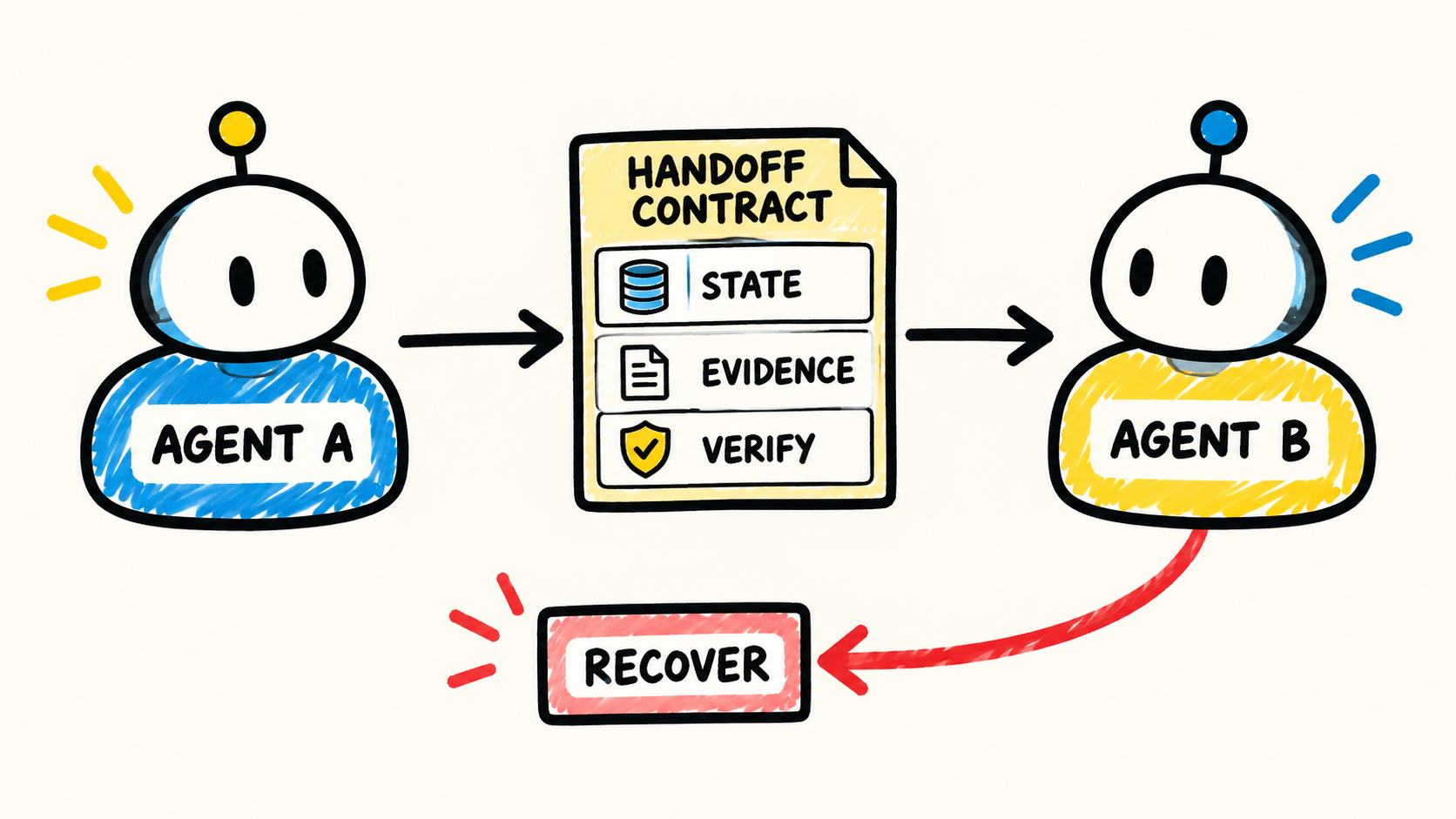

A self-correcting agent loop in CI is the workflow where a verifiable failure goes back to Codex, Claude Code, or another coding agent with minimal context, tight scope, and a stopping rule. The goal is not to let the agent own the pipeline. It is to make CI return enough evidence for a small, reviewable repair.
In 2026, GitLab reported that 85% of respondents see review and validation as the new bottleneck for AI-generated code (GitLab, "AI Accountability Report", 2026, retrieved 2026-07-08). If agents create PRs faster, the pipeline needs to answer with evidence, not more discussion.
Practical summary
- The loop should receive a failure, short log, command, and retry limit.
- The agent should touch only the smallest scope that explains the failure.
- The PR must show the test, command output, and residual risk.
- If the second attempt fails for the same reason, call a person.
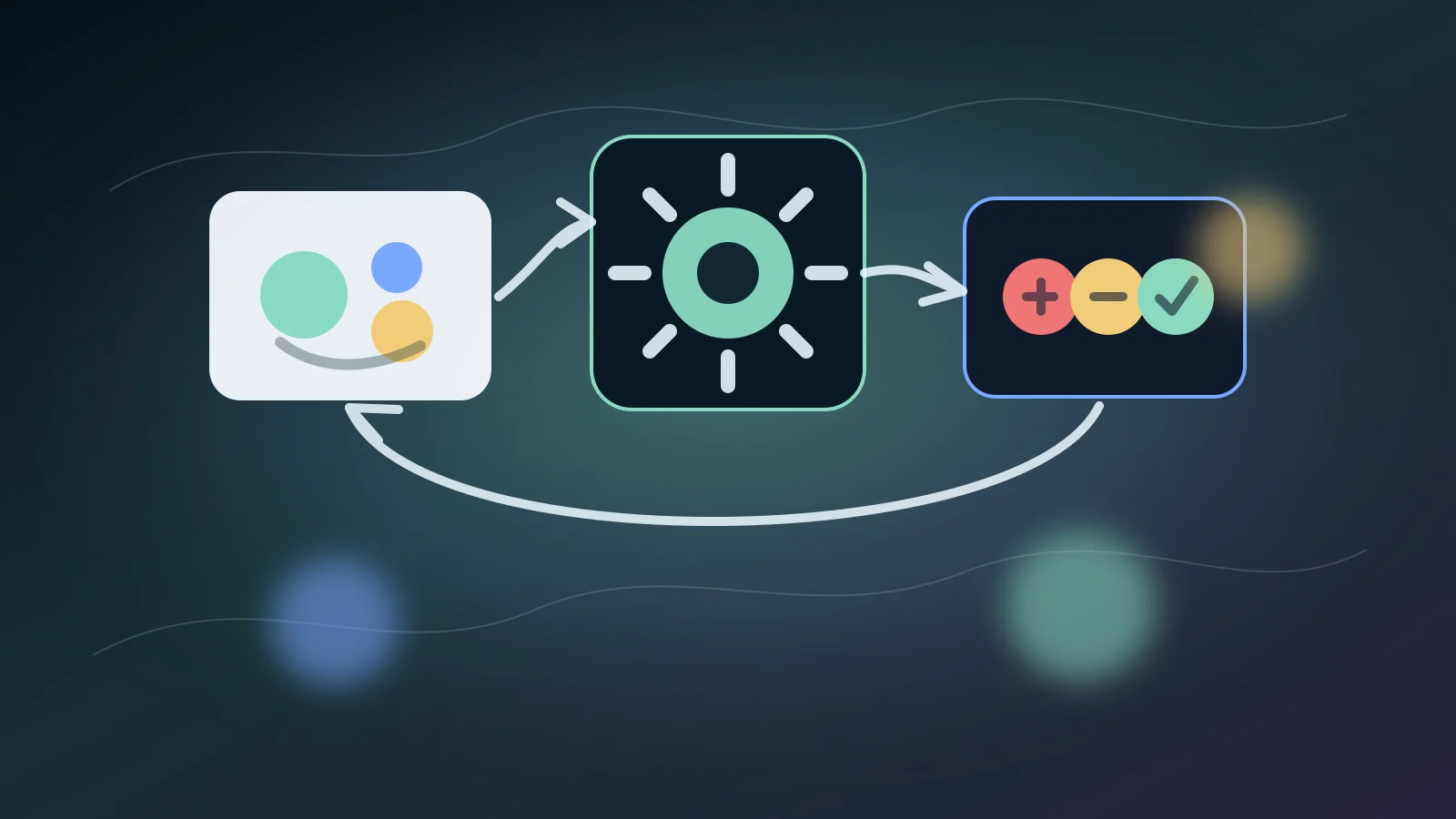
Why did CI repair loops become urgent?
In 2026, GitLab found that 91% of organizations use two or more AI coding tools and that 78% report faster code writing and commits (GitLab, "AI Accountability Report", 2026, retrieved 2026-07-08). CI repair became urgent because generation sped up before verification.
The common mistake is treating a CI failure as a message a human must translate by hand. In an agentic workflow, the failure should already be machine input: command, relevant log excerpt, touched files, scope boundary, and blocking reason. That lowers the chance that an agent tries to "improve" areas that never failed.
This post extends PR evals for coding agents in CI and executable specs for coding agents. The timing is different: here the focus is after failure, when the pipeline must return feedback the agent can execute.
Citable capsule: A self-correcting loop in CI responds to the validation bottleneck. GitLab reported that 85% see review and validation as the bottleneck (GitLab, "AI Accountability Report", 2026); therefore, each failure should become structured feedback with a command, minimal log, scope, and retry limit.
What is the minimum contract for a self-correcting loop?
In 2026, DORA reported that 90% of technology professionals use AI at work and that more than 80% believe it increased their productivity (DORA, "Balancing AI tensions", 2026, retrieved 2026-07-08). The minimum contract exists to turn that productivity into a verifiable change.
A good loop has five fields. First, the failure that triggered the workflow. Second, the command that reproduces it. Third, the file scope the agent may touch. Fourth, the success condition. Fifth, the stopping rule. Without that, the agent receives an exception and invents a project.
failure:
  command: "npm run test -- session-renewal"
  evidence: ".ci/failures/session-renewal.log"
allowed_scope:
  - "src/auth/session.service.ts"
  - "tests/auth/session-renewal.spec.ts"
success:
  - "the failed command passes again"
  - "npm run typecheck still passes"
limits:
  attempts: 2
  no_database_migration: true
  no_secret_change: true
stop_if:
  - "the same failure appears twice"
  - "the patch touches a file outside scope"
  - "the fix requires a secret or external access"
The contract can live in an issue, a PR comment, or a CI-generated artifact. The point is not to depend on chat memory. For long Codex and Claude Code flows, I use RemoteCode to reduce repeated context in agentic coding loops because it is my own tool and fits this cost and continuity problem directly.
Practical experience: when I tested this pattern on backend tasks, the loop became useful only after the failure carried scope and a stopping rule. Before that, the agent tended to fix nearby symptoms and create diffs that looked good but were hard to review.
Citable capsule: The minimum repair contract has failure, command, scope, success, and stop conditions. DORA measured AI adoption at 90% of technology professionals (DORA, "Balancing AI tensions", 2026); without a contract, that adoption expands local productivity and pipeline rework.
How should CI give useful feedback without dumping context?
In 2026, OpenAI documented that codex exec runs Codex in scripts and CI, with JSON Lines events for messages, commands, file changes, MCP calls, and failures (OpenAI Developers, "Non-interactive mode", 2026, retrieved 2026-07-08). Useful feedback is small, structured, and tool-readable.
Do not send the entire log from a long job. Send the failed command, relevant tail, report path, PR diff, and scope policy. The agent can read more if needed, but the first packet should orient it, not drown it.
OpenAI also published an iterative repair example with three phases: review, repair, and validation (OpenAI Developers, "Build iterative repair loops with Codex", 2026, retrieved 2026-07-08). The important detail is separation. Review does not edit. Repair does not decide completion alone. Validation returns the remaining delta.
{
  "command": "npm run test -- session-renewal",
  "status": "failed",
  "log_file": ".ci/failures/session-renewal.log",
  "changed_files": [
    "src/auth/session.service.ts",
    "tests/auth/session-renewal.spec.ts"
  ],
  "request": "apply the smallest fix that makes the command pass"
}
Citable capsule: CI feedback for an agent should be structured, not bulky. OpenAI documented
codex execwith JSON Lines output; that makes failures machine-readable events with command, log, changed file, and next action.
Where should limits sit so the agent does not make the PR worse?
In 2026, the codex exec documentation says non-interactive mode runs in a read-only sandbox by default and recommends workspace-write for controlled edits (OpenAI Developers, "Non-interactive mode", 2026, retrieved 2026-07-08). The limit belongs before editing, not after damage.
Use an isolated runner, short-lived token, minimum permissions, and a separate branch. In Codex, prefer --sandbox workspace-write for repository repairs and avoid broad access outside controlled environments. In Claude Code GitHub Actions, restrict tools, events, and workflow permissions to the actual use case.
The Claude Code Action security documentation recommends limiting allowed tools and using scoped GITHUB_TOKEN when non-write users are allowed (Anthropic, "claude-code-action security", 2026, retrieved 2026-07-08). It also warns against checking out an untrusted ref into the workspace before the action in pull_request_target or workflow_run flows.
Citable capsule: A self-correcting loop needs preventive limits. Codex uses a read-only sandbox by default in automation, and Anthropic recommends minimum GitHub Action permissions; together, those controls keep a test failure from becoming a broad rewrite.
How does the PR prove the repair was legitimate?
In 2026, GitHub reported that Copilot code review processed more than 60 million reviews. The same article says more than one in five GitHub reviews involves an agent (GitHub, "Agent pull requests are everywhere", 2026, retrieved 2026-07-08). The PR must prove the repair because human review became the bottleneck.
Ask for short evidence in the PR body. The agent should show the failed command, passing command, patch summary, residual risk, and why it did not touch neighboring areas. If the fix changed both test and implementation, the order matters: failing test, patch, passing test.
| PR evidence | Validator | Blocks when |
|---|---|---|
| Failed command | CI | There is no clear reproduction. |
| Small patch | Reviewer | A file outside scope changed without reason. |
| Post-patch verification | Branch protection | Test, typecheck, or build fails. |
| Residual risk | Code owner | Sensitive area changed without owner review. |
| Attempts used | Automation | The retry limit was exceeded. |
OpenAI showed in a long-horizon task example that Codex ran lint, typecheck, tests, build, and export commands during verification milestones (OpenAI Developers, "Run long horizon tasks with Codex", 2026, retrieved 2026-07-08). That is the standard: the narrative only matters when it carries verification.
That care also responds to a maintenance risk. In 2026, the study "More Code, Less Reuse" found that agents tend to miss reuse opportunities and introduce more redundancy in AI-generated PRs (arXiv, "More Code, Less Reuse", 2026, retrieved 2026-07-08).
Citable capsule: An agentic repair PR needs proof, not trust. GitHub reported more than 60 million Copilot code review runs (GitHub, "Agent pull requests are everywhere", 2026); at that volume, reproduction command, small patch, and post-patch verification are the shared language among agent, CI, and reviewer.
When should the loop stop and call a person?
In 2026, GitLab reported that 92% face some governance challenge with AI-generated code. The same report says 80% adopted AI tools faster than policies to govern them (GitLab, "AI Accountability Report", 2026, retrieved 2026-07-08). The stopping rule is governance, not a minor operational detail.
Stop when the same failure returns twice, when the patch must touch a file outside scope, or when the fix requires a secret. Also stop when data risk appears, when the agent changes a public API, or when the cause looks like infrastructure flakiness. In those cases, persistence only buys more diff to review.
The Codex Goals documentation describes a persistent objective as a contract with completion condition, verification, and constraints, including stops for success, pause, budget, or blocker (OpenAI Developers, "Using Goals in Codex", 2026, retrieved 2026-07-08). The same logic applies to CI: the loop must know how to end.
Citable capsule: A good self-correcting loop has an explicit stop. Because 92% report AI-code governance challenges (GitLab, "AI Accountability Report", 2026), automation should end when it repeats a failure, touches forbidden scope, requires secrets, or finds a risk that needs human judgment.
What can you implement this week?
In 2025, OpenAI published a cookbook that triggers Codex when a GitHub Actions workflow fails. The example creates a fix PR from the broken branch (OpenAI Developers, "Use Codex CLI to automatically fix CI failures", 2025, retrieved 2026-07-08). The minimum viable version should start reviewable, not fully autonomous.
Implement three pieces. First, save reduced logs under .ci/failures/. Second, create a job that runs only on failure and opens a PR from a separate branch. Third, require the PR to include executed commands and retry count. Do not enable auto-merge in the first cycle.
name: agent-repairs-ci
on:
  workflow_run:
    workflows: ["CI"]
    types: [completed]
permissions:
  contents: write
  pull-requests: write
jobs:
  repair:
    if: $false
    runs-on: ubuntu-latest
    steps:
      - uses: actions/checkout@v4
      - run: npm ci
      - run: node scripts/ci/summarize-failure.mjs
      - run: codex exec --sandbox workspace-write "$(cat .ci/failures/prompt.txt)"
      - run: npm test
Then connect branch protection, code owners, and an automatic evidence comment. If the second repair fails, label the PR as blocked for human review. The gain comes from a short cycle, not from pretending the agent became accountable for the system.
Citable capsule: The first repair loop should open a reviewable PR, not merge by itself. OpenAI published a Codex workflow for CI failures; the prudent version saves a short log, runs in a sandbox, limits retries, and hands branch protection evidence.
FAQ about self-correcting loops in CI
Does a self-correcting loop replace human code review?
No. In 2026, GitHub reported that more than one in five reviews involves an agent (GitHub, "Agent pull requests are everywhere", 2026, retrieved 2026-07-08). That increases the need for human review when API, security, data, or architecture changes.
How many attempts should the agent get?
Two attempts are a good initial default. In 2026, GitLab reported that 85% see validation as a bottleneck (GitLab, "AI Accountability Report", 2026, retrieved 2026-07-08). If the second attempt fails for the same reason, context or judgment is missing.
Can I use danger-full-access in CI?
Only in an isolated, controlled runner. In 2026, OpenAI documented danger-full-access as an option for controlled environments and recommended workspace-write for new automation (OpenAI Developers, "Non-interactive mode", 2026, retrieved 2026-07-08). For a normal PR, prefer short-lived tokens and file scope.
What should the agent receive from the log?
Give it the minimum that reproduces the failure. In 2026, OpenAI documented JSON Lines events in codex exec (OpenAI Developers, "Non-interactive mode", 2026, retrieved 2026-07-08). That favors command, status, log file, diff, and next action.
Closing
A self-correcting agent loop in CI is not unrestricted autonomy. It is feedback engineering. The agent receives a small failure, applies a small change, runs a small proof, and delivers a PR that people and branch protection can reject.
Start with the next repetitive failure. Capture the minimal log, write the repair contract, constrain the sandbox, and require evidence in the PR. If the loop stops early, it did not fail. It protected the repository from a fix that still needed judgment.
Sources consulted
- GitLab, "AI Accountability Report", retrieved 2026-07-08, https://ir.gitlab.com/news/news-details/2026/GitLab-Research-Reveals-Organizations-Are-Generating-AI-Code-Faster-Than-They-Can-Control-It/default.aspx
- DORA, "Balancing AI tensions: Moving from AI adoption to effective SDLC use", retrieved 2026-07-08, https://dora.dev/insights/balancing-ai-tensions/
- GitHub, "Agent pull requests are everywhere. Here's how to review them", retrieved 2026-07-08, https://github.blog/ai-and-ml/generative-ai/agent-pull-requests-are-everywhere-heres-how-to-review-them/
- arXiv, "More Code, Less Reuse: Investigating Code Quality and Reviewer Sentiment towards AI-generated Pull Requests", retrieved 2026-07-08, https://arxiv.org/abs/2601.21276
- OpenAI Developers, "Non-interactive mode", retrieved 2026-07-08, https://developers.openai.com/codex/noninteractive
- OpenAI Developers, "Build iterative repair loops with Codex", retrieved 2026-07-08, https://developers.openai.com/cookbook/examples/codex/build_iterative_repair_loops_with_codex
- OpenAI Developers, "Run long horizon tasks with Codex", retrieved 2026-07-08, https://developers.openai.com/blog/run-long-horizon-tasks-with-codex
- OpenAI Developers, "Using Goals in Codex", retrieved 2026-07-08, https://developers.openai.com/cookbook/examples/codex/using_goals_in_codex
- OpenAI Developers, "Use Codex CLI to automatically fix CI failures", retrieved 2026-07-08, https://developers.openai.com/cookbook/examples/codex/autofix-github-actions
- Anthropic, "Claude Code GitHub Actions", retrieved 2026-07-08, https://code.claude.com/docs/en/github-actions
- Anthropic, "claude-code-action security", retrieved 2026-07-08, https://github.com/anthropics/claude-code-action/blob/main/docs/security.md