


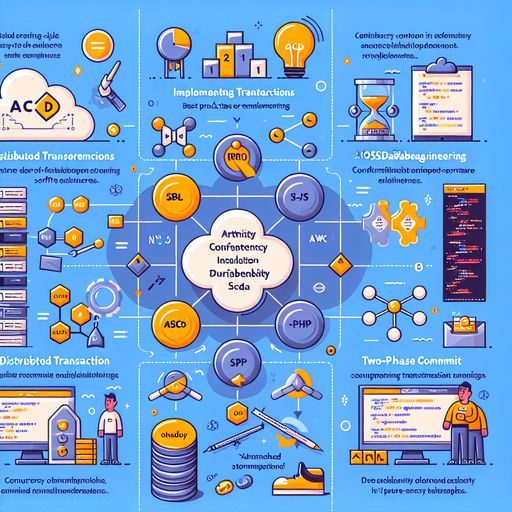
Transactions lie at the heart of any robust application that deals with sensitive or critical data updates. Whether you’re developing a high-traffic e-commerce platform, a financial services dashboard, or a social media application, the integrity of your data hinges on well-established transaction mechanisms. In modern Software Engineering, the term “transactions” extends beyond simple database commits and rollbacks. It includes distributed transactions, sophisticated concurrency controls, and advanced patterns like Sagas and Two-Phase Commit (2PC). Below, we’ll explore the foundational concepts of transactions, walk through their use in both SQL and NoSQL databases, and delve into how these principles apply to frameworks such as Node.js, PHP with Laravel and CodeIgniter, and even to Serverless architectures on platforms like AWS, Google Cloud, and Azure.
Understanding Transactions and Their Core Principles
A transaction is a sequence of operations that must either succeed as a whole or fail altogether. Transactions ensure atomicity, consistency, isolation, and durability—commonly encapsulated by the ACID acronym. Here’s a quick overview:
• Atomicity: Every step in a transaction is part of an indivisible unit of work. If one action fails, the entire transaction is rolled back.
• Consistency: When a transaction finishes, the system must be in a valid state, adhering to all predefined business and data rules.
• Isolation: Concurrent transactions shouldn’t negatively affect each other. Operations from one transaction should not “interleave” in a way that compromises data integrity.
• Durability: Once a transaction commits, its changes survive permanently, even if the system crashes or restarts.
In simpler monolithic applications—where your database is often a single relational or NoSQL store—these ACID properties might be straightforward to manage. However, in modern architectures involving microservices, distributed data stores, and external APIs, ensuring transactional guarantees requires advanced techniques and infrastructure considerations.
Transactions in SQL Databases
Relational databases such as MySQL, PostgreSQL, and Microsoft SQL Server are traditionally built with strong transaction mechanisms. You typically begin a transaction, perform multiple SQL operations, and either commit or roll back the changes. In Node.js or PHP, you’d leverage the driver’s transaction API, ensuring any errors trigger a rollback. For example, in Node.js using a PostgreSQL client:
const { Client } = require('pg');

(async () => {
  const client = new Client();
  await client.connect();

  try {
    await client.query('BEGIN');
    await client.query('UPDATE accounts SET balance = balance - 100 WHERE id = $1', [1]);
    await client.query('UPDATE accounts SET balance = balance + 100 WHERE id = $2', [2]);
    await client.query('COMMIT');
  } catch (err) {
    await client.query('ROLLBACK');
    console.error('Transaction error:', err);
  } finally {
    client.end();
  }
})();
The same principle applies in PHP frameworks like Laravel or CodeIgniter, which provide built-in transaction helpers. For instance, in Laravel:
DB::transaction(function () {
    DB::table('accounts')->where('id', 1)->decrement('balance', 100);
    DB::table('accounts')->where('id', 2)->increment('balance', 100);
});
Under the hood, these frameworks handle the BEGIN, COMMIT, and ROLLBACK statements, making transaction management more accessible, readable, and maintainable.
Transactions in NoSQL Databases
NoSQL databases, such as MongoDB and Amazon DynamoDB, have historically provided limited transactional guarantees. However, as these systems mature, many now offer multi-document or multi-item transactions. MongoDB supports ACID transactions at the document level and even across multiple documents when using replica sets or sharded clusters. This feature opens the door for Node.js or TypeScript-based applications to handle complex operations while maintaining data integrity.
For instance, in MongoDB (using a Node.js driver):
const session = client.startSession();
session.startTransaction();

try {
  await accountsCollection.updateOne({ _id: 1 }, { $inc: { balance: -100 } }, { session });
  await accountsCollection.updateOne({ _id: 2 }, { $inc: { balance: 100 } }, { session });
  await session.commitTransaction();
} catch (err) {
  await session.abortTransaction();
  console.error('Transaction error:', err);
} finally {
  await session.endSession();
}
In serverless environments like AWS Lambda or Azure Functions, leveraging NoSQL transactions requires a bit more planning. Connections need to be created efficiently, and the function should handle concurrency gracefully. Consider caching connections, reusing sessions, and ensuring error handling is robust since serverless executions can scale horizontally, contending for the same data resources.
Distributed Transactions and Microservices
With the rise of microservices and distributed systems, transactions can become more complex. A traditional single-database transaction may not be sufficient when a user action triggers a cascade of events that span multiple services, heterogeneous data sources, or external APIs. In these scenarios, distributed transaction protocols like the Two-Phase Commit (2PC) or the Saga pattern come into play.
Two-Phase Commit (2PC)
2PC attempts to coordinate a transaction across multiple resources by breaking the commit process into two phases: a “prepare” phase and a “commit” phase. Each resource manager (e.g., a database) confirms that it’s ready to commit, then a final commit instruction is issued to all participants. While 2PC is a solid theoretical model, it can be slow and prone to blocking in environments with high latency or frequent node failures.
Saga Pattern
The Saga pattern provides a more asynchronous approach to distributed transactions by modeling each step in a transaction as a local operation followed by a compensating action in case of failure. Instead of a central coordinator enforcing 2PC, each service does its own local transaction, and if a later step fails, previously completed steps are undone through compensating events. This ensures that services remain loosely coupled, which is advantageous in cloud-based, large-scale ecosystems where horizontal scaling and resilience are paramount.
sequenceDiagram
    participant Service A
    participant Service B
    participant Service C

    Service A->>Service B: Perform local transaction
    Service B->>Service C: Perform local transaction
    alt Success
        Service C->>Service A: OK
    else Failure
        Service C->>Service B: Trigger compensating action
        Service B->>Service A: Trigger compensating action
    end
Ensuring Concurrency Control
When implementing transactional systems, especially in a multi-threaded or distributed environment (such as Node.js clusters, Laravel queues, or microservices on AWS EC2 instances), concurrency control is critical. Here are some best practices:
-
Use Optimistic Locking: Adopt a strategy where you assume conflicts are rare. For instance, add a version field to documents or rows, and increment it each time data is updated. If a conflict arises—say another transaction modified the record—the transaction can be retried or rolled back gracefully.
-
Use Pessimistic Locking: Lock resources explicitly, preventing other transactions from reading or writing data until the lock is released. This can be viable but may result in lower throughput if overused, especially in high-concurrency environments.
-
Isolate Critical Sections: If your application has a critical operation that can’t fail or be repeated, ensure that the concurrency boundary is tightly controlled. Techniques include queue-based processing or using an atomic counter in Redis.
-
Leverage Database Isolation Levels: Modern relational databases offer multiple isolation levels (e.g., Read Uncommitted, Read Committed, Repeatable Read, Serializable). Adjusting these can reduce concurrency issues like dirty reads, non-repeatable reads, and phantom reads, though higher levels can impact performance.
Transactions in Serverless and DevOps Paradigms
In DevOps workflows and serverless environments, managing transactions can be more complicated. However, certain design patterns and cloud-native approaches can simplify the process:
• Event-Driven Transactions: Services like AWS Lambda or Google Cloud Functions often rely on triggers from data streams (Amazon Kinesis, Google Pub/Sub, or Azure Event Hubs). You can model your transactions as a series of events, each representing a state change in the system. If an event fails, a compensating event can be fired to revert or fix the state.
• Idempotent Operations: In a system designed to handle repeated calls gracefully, repeated invocations of the same event result in the same final state. This approach can eliminate the need for strict distributed transactions, instead ensuring “eventual consistency.”
• Orchestration Services: Platforms like AWS Step Functions and Azure Durable Functions provide built-in orchestration that can help developers chain multiple serverless functions into a transaction-like workflow. The system manages retries, rollbacks (via compensation logic), and state transitions.
Best Practices for Transaction Implementation
-
Design with Failure in Mind: Assume that partial failures are inevitable, especially in distributed systems. Build workflows that gracefully handle failures, retries, and compensations.
-
Plan for Scalability: As your application scales in terms of traffic or data size, a monolithic transaction approach might become a bottleneck. Investigate sharding strategies, caching, and other forms of partitioning to distribute the load.
-
Minimize Transaction Scope: The longer a transaction stays open, the higher the chance of conflicts. Keep your transaction’s critical section as small as possible. In frameworks like Node.js, avoid spinning up lengthy operations inside transaction blocks.
-
Monitor and Log: Transaction-related issues can be subtle. Log transaction beginnings, commits, rollbacks, and concurrency issues. Use monitoring tools (e.g., AWS CloudWatch, Google Stackdriver, Azure Monitor) to track cluster or service health.
-
Documentation and Automation: Document your transaction boundaries and data flows. Automate testing for edge cases—particularly around concurrency and data inconsistency. Continuous Integration/Continuous Deployment (CI/CD) pipelines should run integration and stress tests that simulate real-world transaction loads.
Applying Transactions to Diverse Tech Stacks
• Node.js and TypeScript: With robust database drivers and libraries like TypeORM or Sequelize, Node.js and TypeScript developers can implement transactions succinctly. Always handle promise rejections carefully to avoid leaving transactions hanging.
• React, Angular, Vue.js: While front-end frameworks don’t directly manage database transactions, they can trigger a series of operations that require transactional integrity on the backend. Ensure that your UI libraries display consistent states and inform the user correctly about ongoing transactions or possible failures.
• PHP using Laravel and CodeIgniter: PHP frameworks excel at simplifying transaction logic. Utilize built-in transaction scaffolds and focus on verifying rollback paths in testing.
• Cloud Platforms (AWS, Google Cloud, Azure): Each cloud vendor provides services for data storage, messaging, and orchestration. From AWS’s DynamoDB Transactions to Google Cloud Spanner (a globally distributed relational database) and Azure Cosmos DB multi-region writes, you have multiple options for robust transactional and quasi-transactional behavior.
Strategic Use Cases for Transactions
-
Financial Services: Banking and payment gateways are the classic examples where strong ACID transactions are necessary. Microservice architectures handling transfers or withdrawals often rely on Saga patterns to coordinate across multiple accounts and third-party gateways.
-
E-commerce: Shopping cart operations, checkout processes, and multi-step order fulfillment are prime candidates for distributed transactions. You might create a new order in MySQL, update product inventory in MongoDB, and process a payment via a remote API.
-
Messaging-Based Workflows: Systems that rely on message brokers like RabbitMQ or Apache Kafka ensure that once a message is consumed, the operation is completed successfully—or rolled back with a compensating transaction. This approach helps maintain consistency across multiple microservices.
-
Serverless Microservices: When using AWS Lambda or Azure Functions, ephemeral compute environments demand statelessness, but transactions can still be simulated using carefully orchestrated events or state machines.
Conclusion
Transactions are a cornerstone of data integrity, ensuring that critical operations either succeed entirely or fail without leaving your system in an inconsistent state. As software systems become more distributed—spanning multiple databases, microservices, and even different cloud platforms—transactional guarantees grow increasingly important yet more challenging to implement. By understanding the ACID properties, leveraging database-specific transaction features, and exploring distributed transaction methodologies like Two-Phase Commit and the Saga pattern, developers can tame the complexity of modern data architectures.
Whether running a Node.js or TypeScript service, building front-end applications in React, Angular, or Vue.js, orchestrating serverless functions in AWS or Google Cloud, or maintaining PHP backends in Laravel or CodeIgniter, developers have a wealth of tools and best practices at their disposal. Mastering transactions in these environments not only safeguards your application’s data but also boosts confidence among stakeholders and end-users. Embracing thorough testing, observability, and scalable design patterns will empower your applications to handle the next wave of distributed, high-demand workloads with grace and resilience.